Afghan Rugs: Interior Design Trends & Investment Value

Jun 04, 2026
Afghan Rugs in Modern Homes: Interior Design Trends, Styling Strategies, and Investment Value
There is a particular moment that every interior designer knows — the moment a room stops being a collection of furniture and becomes a home. It rarely comes from the sofa or the lighting fixture. More often than not, it comes from the floor. A hand-knotted Afghan rug laid beneath a mid-century walnut coffee table, its deep burgundy field pulling together the rust leather chair and the aged brass lamp, suddenly makes the entire room feel intentional. Considered. Alive.
What makes Afghan handmade rugs so extraordinary in modern interiors is not simply their beauty, though that beauty is undeniable. It is the fact that they carry three distinct kinds of value simultaneously — aesthetic, cultural, and financial — in a way that virtually no other home furnishing can claim. A rug purchased today for $3,000 might reasonably be worth $6,500 to $9,000 in fifteen years, provided it is cared for properly and selected with quality in mind. Meanwhile, it transforms your living room every single day between now and then.


Afghan Handmade Rugs | Aseel
That convergence — genuine design power combined with real appreciation potential — is why Afghan rugs have quietly become one of the most intelligent purchases an affluent homeowner or interior designer can make. Not because they are a financial instrument, but because they function simultaneously as a statement piece, a cultural artifact, and an asset that, unlike most home décor, does not depreciate the moment it leaves the showroom floor. At Aseel, every rug you browse comes directly from the Afghan artisan who made it — which means full provenance documentation from day one.
This guide is for people who want to understand both dimensions fully. You will find specific room-by-room styling strategies rooted in current design trends, honest investment data with real-world appreciation examples, a framework for choosing between new and vintage pieces, and a clear-eyed discussion of what it actually takes to buy an Afghan rug that holds and grows its value over time.
Why Afghan Rugs Belong in Modern Spaces
The most persistent misconception about Afghan handmade rugs is that they belong in traditional rooms — heavy oak furniture, dark paneling, formal parlors. That misconception is costing a great many homeowners something genuinely beautiful. The reality is that Afghan rugs are among the most versatile anchoring elements in contemporary design, precisely because their visual language operates on a different register than anything modern manufacturing can produce.
Consider what a rug does in a room architecturally. It defines zones, reduces acoustic harshness, creates visual warmth, and anchors furniture groupings. Any rug does this. What an Afghan hand-knotted rug does additionally is introduce what designers call "living texture" — the slight irregularity of hand-tied knots, the way natural wool dyes shift subtly across the field, the dimensional quality of pile that machine weaving cannot replicate. These qualities do not compete with modern furniture; they complete it.
There is also a psychological dimension that interior designers discuss openly among themselves but rarely explain to clients. Spaces dominated by contemporary materials — polished concrete, glass, brushed steel, lacquered surfaces — can feel cold and transient, however beautifully designed. The brain reads these materials as impermanent, as stage sets. An Afghan rug, by contrast, carries what designers sometimes call "earned weight" — the visible evidence of genuine craft, age, and meaning. Placed in a modern interior, it signals that the room is inhabited by someone with real taste rather than someone who simply bought a room. That psychological warmth translates directly into how guests perceive a space and how the people who live in it feel there day to day.
The design principle at work is intentional contrast — not contrast for its own sake, but the kind that makes both elements stronger. A sleek sofa looks better beside something that was made with human hands. A stark minimalist dining room is completed rather than interrupted by a Mawri-pattern Afghan rug beneath the table. The traditional and the contemporary do not cancel each other out; they create a sophisticated dialogue that neither could sustain alone.
Design Trends That Are Making Afghan Rugs Essential Right Now
Several converging currents in interior design have made Afghan rugs more relevant in the mid-2020s than at any point in recent memory. Understanding these trends matters because they validate the design choices being made by serious homeowners right now, and because they suggest that the current appetite for authentic handcraft in interiors is not a passing moment but a structural shift.
Maximalist authenticity has displaced the sterile minimalism that dominated interiors for most of the 2010s. The reaction against empty rooms filled with pale, machine-made everything has been building for years and has now arrived with full force in the work of the designers whose projects appear in Architectural Digest and The World of Interiors. Maximalism in this context does not mean clutter — it means density of meaning. Layered textiles, collected objects with real provenance, pattern alongside texture. Afghan rugs, with their intricate geometric designs and centuries of encoded symbolism, are ideally positioned for this moment.
Cultural eclecticism — the thoughtful integration of objects from non-Western design traditions — has moved from bohemian styling into high-end residential design with remarkable speed. Herati-pattern Afghan rugs, with their intricate fish-and-flower medallion fields, are appearing in Parisian apartments and New York townhouses alongside Japanese ceramics and Moroccan side tables. The effect is never themed or touristic when handled well; it is cosmopolitan and deeply considered.
The slow furniture movement is perhaps the most important trend for understanding Afghan rug value. A generation of homeowners who grew up replacing furniture every few years is now actively rejecting disposability. They want objects made to last decades, objects they can pass down, objects with legible craft. Hand-knotted Afghan rugs — some of which take a single artisan family more than a year to complete — are the antithesis of fast furniture. Their durability is structural: a well-made Afghan rug with a dense knot count and high-quality wool will outlast the house it sits in if cared for properly.
Warmth as a design principle has evolved beyond the Scandinavian-lite version of throws and candles into something richer. It now means tactile depth, color saturation, materials that invite touch, spaces that feel genuinely sheltering. An Afghan rug in deep madder red or aged indigo delivers exactly this quality in a way that no synthetic alternative can approximate.
Each of these trends benefits Afghan handmade rugs directly. None of them is a trend Afghan rugs merely happen to align with — in important ways, Afghan rugs are what each of these trends is reaching toward.
Room-by-Room: Styling Afghan Rugs for Maximum Design Impact
The single most common mistake in rug placement is choosing scale incorrectly. An undersized rug creates visual disconnection; an oversized one loses its anchoring effect. What follows is a room-by-room strategy grounded in actual design practice.
Living Room: The Rule of Float
In a living room, the Afghan rug functions as the primary organizational element of the entire space. The classic move is to float all major furniture legs — sofa, chairs, coffee table — either fully on the rug or at minimum with front legs resting on it. A rug that sits stranded in the center of the room while furniture orbits it at a distance creates visual fragmentation that no amount of beautiful furniture can overcome.
For a typical living room of 14 by 16 feet or larger, an 8 by 10 or 9 by 12 Afghan rug positions furniture appropriately. Color strategy here should be led by the rug, not the walls — select the rug first, then choose upholstery and accent colors from within its palette. A traditional Afghan rug with a deep red field, ivory border, and navy accents gives you three strong colors to work with throughout the room. Pull the ivory into throw pillow fabric. Echo the navy in a lamp base or side chair. Let the red anchor without repeating it literally anywhere else.
Bedroom: Warmth and the Morning Ritual
The bedroom placement that interior designers return to most consistently is running the rug beneath the bottom two-thirds of the bed, extending substantially on both sides. A 9 by 12 rug under a king bed, placed so that two to three feet extends on each side and at the foot, means that bare feet land on wool every single morning — a sensory experience that genuinely affects how a room feels to inhabit.
Afghan rugs in bedrooms work particularly well in softer, abrash-rich colorways where the natural dye variation across the field creates a meditative visual depth. A faded Sultanabad-style Afghan rug in worn madder and ivory creates an effect in a bedroom that no decorator-sourced reproduction can match: the sense of something beautiful that has been lived with and will continue to be.
Home Office: Grounding and the Psychology of Craft
The home office is an underserved room in most rug conversations, and one of the most rewarding placements. Beneath a large wooden desk with a reading chair and side table, an Afghan rug defines the workspace as distinct from the surrounding house while introducing enough visual complexity to stimulate without distracting.
There is genuine psychological research supporting the idea that moderate visual complexity in work environments improves creative output compared to both sterile white spaces and chaotic ones. A hand-knotted Afghan rug with a geometric Mawri pattern or a structured Bukhara gul design sits precisely in that productive zone. For executives and creative professionals who receive clients at home, an Afghan rug in the office communicates cultivated taste and stability in a way that an expensive desk alone does not.
Entryway: First Impressions as Design Philosophy
The entryway rug is the first thing a guest encounters and the last thing they see on the way out — which means it carries disproportionate weight in how the entire home is perceived. Afghan runners — typically 2.5 by 8 or 3 by 10 feet — are exceptional here. The dense wool pile of a hand-knotted Afghan rug tolerates foot traffic that would destroy a lesser piece, and the traditional border designs of Afghan runners frame the entry passage architecturally.
Darker-ground Afghan rugs in navy, charcoal-blue, or deep burgundy are forgiving of inevitable dirt and show wear beautifully as they age — developing the kind of patina that actually increases perceived quality over time.
Dining Room: Scale Above Everything
The dining room presents the most specific sizing requirement of any room. The rug must extend at least 24 inches beyond the table edge on all sides so that chairs remain on the rug when pulled out. This is not an aesthetic preference — it is functional, because a chair leg catching the rug edge will curl and damage it over time.
For a standard dining table seating eight, a 9 by 12 or 10 by 14 Afghan rug is typically appropriate. The visual effect of a beautifully patterned Afghan rug in a dining room is one of the most powerful transformations in residential design: it turns eating together into something that feels ceremonial and worthwhile. Afghan rugs in dining rooms also age gracefully — the occasional spill handled quickly, the decades of dinner parties — these add to the rug's story rather than diminishing it.
Staircase Runners: Architectural Integration
A hand-knotted Afghan runner installed on a staircase transforms a functional transitional space into a design feature. The repetitive pattern elements of traditional Afghan weaving — the recurring gul medallions of a Bukhara design — work particularly well on stairs because each step frames a section of the pattern in a way that creates rhythmic visual movement as you ascend. A quality runner installed correctly will last thirty to forty years with proper care.
Color Selection: Matching Afghan Rugs to Modern Interiors
Color is where most rug purchases succeed or fail. Afghan rugs are available across a broader spectrum than most buyers realize, and understanding the design and investment implications of color adds another dimension to the decision.
Traditional warm palette — burgundy, rust, and deep red — these colors derive traditionally from madder root and pomegranate rind, natural dyes that age into increasingly complex, luminous tones over decades. A new Afghan rug in bright madder red will, in fifteen years, develop the rich, slightly faded warmth that auction houses charge significant premiums for. Warm-palette Afghan rugs work in virtually any room with wood furniture, leather upholstery, or exposed brick, and they are consistently among the most actively traded pieces in the secondary market.
Blue Afghan rugs — navy, cobalt, and indigo — represent perhaps the strongest contemporary design choice for modern homes. Afghan rugs with navy or indigo grounds, often featuring ivory or gold pattern elements, have a graphic quality that bridges traditional and contemporary aesthetics with particular elegance. These rugs integrate seamlessly with the grey-and-blue palettes that continue to dominate modern residential design. Natural indigo dyes create color depth that is genuinely irreproducible synthetically, which is part of why blue-ground pieces have shown strong appreciation at the collector level.
Earth tones — cream, taupe, and natural camel — are having an extended design moment driven by biophilic design and the move toward warm neutrals. Afghan rugs in this palette, often Ziegler-style pieces with abrash-rich ivory fields and soft botanical patterns, read as sophisticated rather than neutral. They work particularly well in rooms with linen upholstery, pale oak floors, and natural stone. The practical consideration is that lighter pieces require more attentive care, but their design versatility is exceptional.
Strong geometric and multi-color tribal patterns — the bold designs of Mawri-weave Afghan rugs — function in interiors as genuine art. These are pieces that anchor a room that would otherwise feel unfinished, and they reward rooms confident enough to let them speak. In contemporary maximalist interiors, a bold-pattern Afghan rug is precisely the organizing principle needed to give visual permission for the layering of other patterns and textures.
The Investment Economics of Afghan Handmade Rugs
Before discussing numbers, an honest framing: Afghan rugs are not a liquid investment, do not come with guaranteed returns, and should never be purchased as a replacement for a diversified financial portfolio. With that said, the historical appreciation data for quality hand-knotted Afghan rugs is genuinely compelling, and understanding the economic fundamentals behind that appreciation helps buyers make better decisions.
The core investment argument rests on five economic fundamentals: supply scarcity, quality degradation in new production, cultural significance, material irreplaceability, and the compounding premium of age and provenance.
Supply scarcity is the most straightforward driver. The population of skilled Afghan weavers — artisans trained in traditional techniques through years of apprenticeship, working with locally sourced high-altitude wool and natural dyes — is not growing. Geopolitical and economic pressures over recent decades have displaced significant artisan communities, disrupted traditional production, and created a global supply of authentically produced Afghan rugs that is meaningfully smaller than it was in 1990. When supply contracts while demand from design-forward buyers in North America, Europe, and the Gulf states remains stable or increases, prices rise.
Historical appreciation provides a useful framework for expectations. A quality Afghan Bukhara rug purchased in 2000 for approximately $2,500 would today be reasonably valued in the $5,500 to $8,000 range in good condition — a compound annual growth rate of roughly 4 to 6 percent, broadly comparable to U.S. real estate over the same period. Exceptional pieces have outperformed these averages significantly: a palace-size Afghan Ersari carpet in very fine condition that sold privately in 2008 for approximately $18,000 was estimated at $38,000 to $45,000 by a specialist dealer in 2024.
The decisive differentiator from purely financial assets is that an Afghan rug improves your daily life between purchase and sale. It anchors your living room, warms your bedroom, impresses your clients, and accumulates aesthetic quality while it appreciates. This dual utility fundamentally changes the calculus.
What separates investment-grade from décor-grade comes down to four factors: knot density (investment-grade pieces generally run above 80 knots per square inch, with exceptional pieces reaching 200 to 300+), wool quality (high-altitude Afghan wool with natural lanolin content outperforms lowland or imported wool significantly over time), dye authenticity (natural dye rugs develop more valuable patina than chrome-dye pieces), and construction integrity. A buyer investing $5,000 in a rug with 120+ KPSI, natural dyes, and documented Afghan provenance is making a categorically different purchase from a buyer spending the same on a piece with 40 KPSI and synthetic dyes — even if both look superficially similar in a photograph. On Aseel, every listing includes the artisan's name, region, materials, and construction details — which means that provenance documentation begins before the purchase is even made
New vs. Vintage: The Investment Question Answered
The honest answer is that it depends on what you are optimizing for — and that both choices can be excellent with the right information.
The case for new Afghan rugs is stronger than many collectors acknowledge. A new hand-knotted Afghan rug purchased directly from an artisan or a transparent importer carries several genuine advantages: you know its complete history from the day the first knot was tied, you can often specify colorway and dimensions, and you can begin building the documented provenance that adds financial value over time. A well-chosen new Afghan rug purchased today at $4,000 to $8,000 could reasonably be worth $9,000 to $18,000 by 2040 if quality and condition hold. New purchases also directly support living artisan families — for buyers who care about both investment and ethical consumption, buying new from a verified source does both simultaneously. Aseel's direct-from-artisan model is built precisely for this: you see the maker, the region, the wool source, and the story behind each piece before committing, which is the kind of transparency that serious buyers should be demanding regardless of where they shop.
The case for vintage Afghan rugs — pieces from the 1950s through 1990s — is grounded in established appreciation and the quality differential of older production. A vintage piece in genuinely good condition has already proven its structural durability. Its natural dyes have developed the patina that the market reliably rewards. Its knot count and wool quality reflect production standards that were more consistently excellent than today's mixed market. And its appreciation trajectory, while already partially realized, typically continues: the premium for condition and age compounds rather than levels off.
The investment verdict: buyers with primarily design goals and secondary investment interest should lean toward high-quality new pieces with documented provenance. Serious collectors building a portfolio of textile assets should focus on pre-1990 vintage pieces in confirmed fine condition, with particular attention to exceptional sizes and unusual regional variants.
Interior Design Case Studies
The following scenarios are illustrative composites that reflect the kinds of transformations interior designers routinely describe. They are presented as design examples, not named client stories.
The minimalist urban apartment. A 1,200-square-foot Manhattan apartment designed around pale oak floors, white plaster walls, and curated Scandinavian furniture had a problem its owner could not articulate: it felt, as she put it, "like a hotel room — beautiful but not mine." The intervention was a single 8 by 10 vintage Afghan Ziegler rug in a faded ivory field with soft terracotta botanical patterns, placed beneath the living room furniture grouping. Nothing else changed. The room acquired visual warmth it had lacked; the Scandinavian furniture looked more intentional in context rather than merely collected; guests began commenting on the apartment as distinctive. The rug cost approximately $6,800 at purchase. A comparable piece in comparable condition is currently estimated at $12,000 to $15,000.
The eclectic brownstone. A three-story Brooklyn townhouse with exposed brick, high ceilings, and deliberately layered furnishings from multiple periods used a large Afghan Ersari carpet — 10 by 14, deep indigo field with complex floral border — in the formal sitting room. Six different chairs from six different decades orient toward each other around it, held together by the carpet's palette of indigo, rust, and ivory. Visitors consistently identify the rug as the room's defining object. The owner purchased it for $14,000 in 2012 and has received two unsolicited purchase offers totaling $26,000 in recent years.
The executive home office. A partner at a Chicago law firm redesigned his home office to receive clients — a room that needed to communicate intellectual authority and cultivated taste simultaneously. A 6 by 9 Afghan hand-knotted rug in a structured Bukhara gul pattern, deep burgundy on ivory, was placed beneath the desk area. Combined with mahogany shelving, aged leather seating, and a single large antique map, the rug gave the room the quality of a space that had been inhabited for decades rather than staged for effect. Multiple clients have inquired about the rug specifically.
The modern farmhouse dining room. A Virginia farmhouse with a contemporary kitchen extension — white shiplap, black steel windows, poured concrete floors — needed something in the dining area that would soften the industrial quality of the finishes without undermining the deliberate aesthetic. A 9 by 12 Afghan rug in warm camel, rust, and ivory geometric patterns was placed beneath a large elm dining table. The geometric pattern of the rug echoed the grid of the steel windows while the wool and natural dyes connected the room to the agricultural landscape visible through them. It cost $5,200 and made the dining room the heart of the home in a way that no furniture change had managed.
The master bedroom retreat. A Los Angeles bedroom designed around linen upholstery, natural oak, and a carefully curated absence of color wanted one element of deep, saturated warmth. An Afghan Sultanabad-style rug — 9 by 12, soft madder red field with ivory Herati pattern — was placed beneath the king bed, extending generously on both sides. The result transformed the room from beautiful to genuinely luxurious in the truest sense: not expensive-looking, but rich with meaning and physical warmth.
Afghan Rugs with Modern Furniture: A Pairing Guide
The principle that unlocks Afghan rugs in contemporary interiors is intentional contrast — the understanding that the value of each element increases when paired with something that completes rather than matches it.
With mid-century modern furniture, Afghan rugs work because both share a commitment to honest materials and functional beauty. The warm tones of a walnut credenza and the natural madder of an Afghan Bukhara rug speak the same material language without being repetitive. Mid-century furniture tends toward lower profiles and cleaner lines, which are shown to maximum advantage by a rug with visible texture and pattern complexity.
In industrial spaces — concrete floors, exposed steel, brick — an Afghan rug performs a humanizing function that is almost architectural in its impact. The industrial materials read as permanent and structural; the Afghan rug reads as chosen and personal. Bold geometric Afghan tribal rugs work particularly well here because their graphic quality holds its own against the visual weight of raw materials.
With Scandinavian minimalist design, the Afghan rug introduces warmth and visual complexity without compromising the clean spatial organization that Scandinavian interiors achieve. A faded, abrash-rich vintage Afghan rug in muted tones reads as discovered rather than decorated — entirely consonant with the Scandinavian preference for objects with genuine stories.
In contemporary maximalist interiors, Afghan rugs are not additions to visual complexity — they are its organizing principle. A strong-pattern Afghan rug gives permission for the layering that maximalism requires: once the rug establishes the palette and register, everything else builds from it rather than competing with it.
In modern farmhouse interiors, Afghan rugs bridge the gap between deliberate rusticity and the clean contemporary lines that distinguish modern farmhouse from its predecessor styles. The natural wool, botanical and geometric patterns, and warm earth palette connect the interior to the agricultural tradition that farmhouse design references while the fine craftsmanship elevates the room beyond simple rusticity.
The unifying principle: Afghan rugs work in modern interiors not despite their traditional character but because of it. The contrast is the design.
Realistic Investment Timeline: What to Actually Expect
For buyers approaching a purchase with genuine investment consciousness, a realistic timeline prevents both impatience and missed opportunity.
Years 0–2 bring a modest initial adjustment — typically 10 to 15 percent below retail purchase price on the secondary market, as with any recently purchased physical object. This reflects nothing about long-term trajectory; it is simply the nature of the retail-to-resale gap.
Years 2–7 bring stabilization and early appreciation. The rug has demonstrated structural durability and begun developing the slight softening of pile and subtle richening of natural dye colors that the market prices positively.
Years 7–15 are where meaningful appreciation typically begins for investment-grade pieces. Natural dyes are visibly deepening in complexity; the wool pile has settled into the characteristic low, dense softness of a genuinely fine aged rug. Appreciation in the range of 5 to 8 percent annually during this phase is not uncommon for genuinely fine pieces in good condition.
Years 15–30 represent the window of serious collector interest. Exceptional pieces in this age range attract auction houses, serious collectors, and institutional buyers. The difference between a 20-year-old piece in excellent condition versus merely good condition can be 40 to 60 percent in realized price — which is why condition maintenance is the highest-return activity in rug investment.
30 years and beyond is where Afghan rugs diverge completely from every other category of home furnishing. A fine hand-knotted Afghan rug becomes more valuable, more beautiful, and more culturally significant with each decade that it is well maintained. Pieces from the 1960s and 1970s are among the most actively sought in today's market.
These trajectories apply to genuinely high-quality pieces with verified provenance and properly maintained condition. They do not apply to low-knot-density rugs, chrome-dye pieces, machine-made imitations, or pieces that have sustained significant damage. The market is unforgiving of quality pretense.
When and How to Sell
The decision to sell a quality Afghan rug should ideally never be primarily financial — the dual-use nature of the asset means holding provides daily utility that selling sacrifices. But when a sale becomes appropriate, the mechanics matter.
Optimal holding periods for maximum realized appreciation are generally 15 to 20 years for new purchases, based on the appreciation curve above. Selling before 10 years sacrifices meaningful appreciation; selling at 20 to 30 years captures a strong portion of long-term value while the seller can still benefit personally from the transaction.
Sales channels vary in price realized versus effort required. Private sale to a known collector or through a specialist dealer typically achieves the highest net price but requires relationships and patience. Major auction houses — Christie's, Sotheby's, Bonhams — achieve strong prices for exceptional pieces but take commissions of 15 to 25 percent and require pieces meeting their quality and provenance thresholds. Online specialist marketplaces have expanded the accessible buyer pool significantly and reward sellers who invest in professional photography and detailed provenance documentation.
Condition is everything. A rug cleaned professionally every three to five years, stored correctly when not in use, kept from sustained direct sunlight, and protected from moth damage will realize a price premium of 30 to 60 percent over a comparable piece in merely fair condition. This is the single most controllable variable in long-term investment performance.
Document everything from day one. Photograph the rug in detail at purchase. Keep receipts and any provenance paperwork. Have the piece appraised by a credentialed textile appraiser every decade. This documentation dramatically accelerates sales negotiations and supports premium pricing.
Frequently Asked Questions
Do Afghan rugs really appreciate in value over time?
High-quality, hand-knotted Afghan rugs with natural dyes and dense knot counts have historically appreciated at rates of 4 to 8 percent annually over 15-to-30-year holding periods, based on comparable sales data from specialist dealers and auction records. This appreciation is not guaranteed and depends heavily on initial quality and ongoing condition maintenance. It applies to investment-grade pieces specifically — medium-quality pieces with synthetic dyes and lower knot counts appreciate far more modestly or not at all.
How do I know if an Afghan rug is investment-grade?
Investment-grade Afghan handmade rugs share four characteristics: high knot density (generally 80 to 300+ knots per square inch), natural dye colorways that will develop patina over decades, high-quality Afghan wool that feels distinctly springy and lanolin-rich, and verifiable provenance as to origin and age. A credentialed rug appraiser can assess all four factors in a single evaluation — worth the cost for any purchase above $3,000. Aseel's listings provide material, construction, and artisan origin details upfront, which gives buyers a strong starting point for that assessment before an appraiser is ever involved.
Should I buy a new or vintage Afghan rug?
For buyers with primarily design goals and secondary investment interest, a high-quality new Afghan rug purchased from a vetted source offers the clearest provenance. For serious collectors prioritizing investment return, vintage pieces from the 1960s through 1980s in confirmed fine condition offer an established appreciation history and the quality premium of older production standards.
How do I match an Afghan rug with modern furniture?
The principle of intentional contrast is your guide: you are not trying to match the rug to your furniture but to create a dialogue between them. Afghan rugs in warm traditional palettes pair naturally with mid-century modern, contemporary maximalist, and modern farmhouse aesthetics. Blue-ground Afghan rugs integrate elegantly with more contemporary or Scandinavian-influenced interiors. Allow the rug to lead the color story of the room.
What size Afghan rug do I need for my living room?
All major furniture pieces should have their front legs resting on the rug at minimum, with all legs fully on it being ideal. For most living rooms of 14 by 16 feet or larger, an 8 by 10 or 9 by 12 rug is appropriate. An undersized rug creates visual disconnection that undermines the entire furniture grouping.
How should I care for an Afghan rug to preserve its investment value?
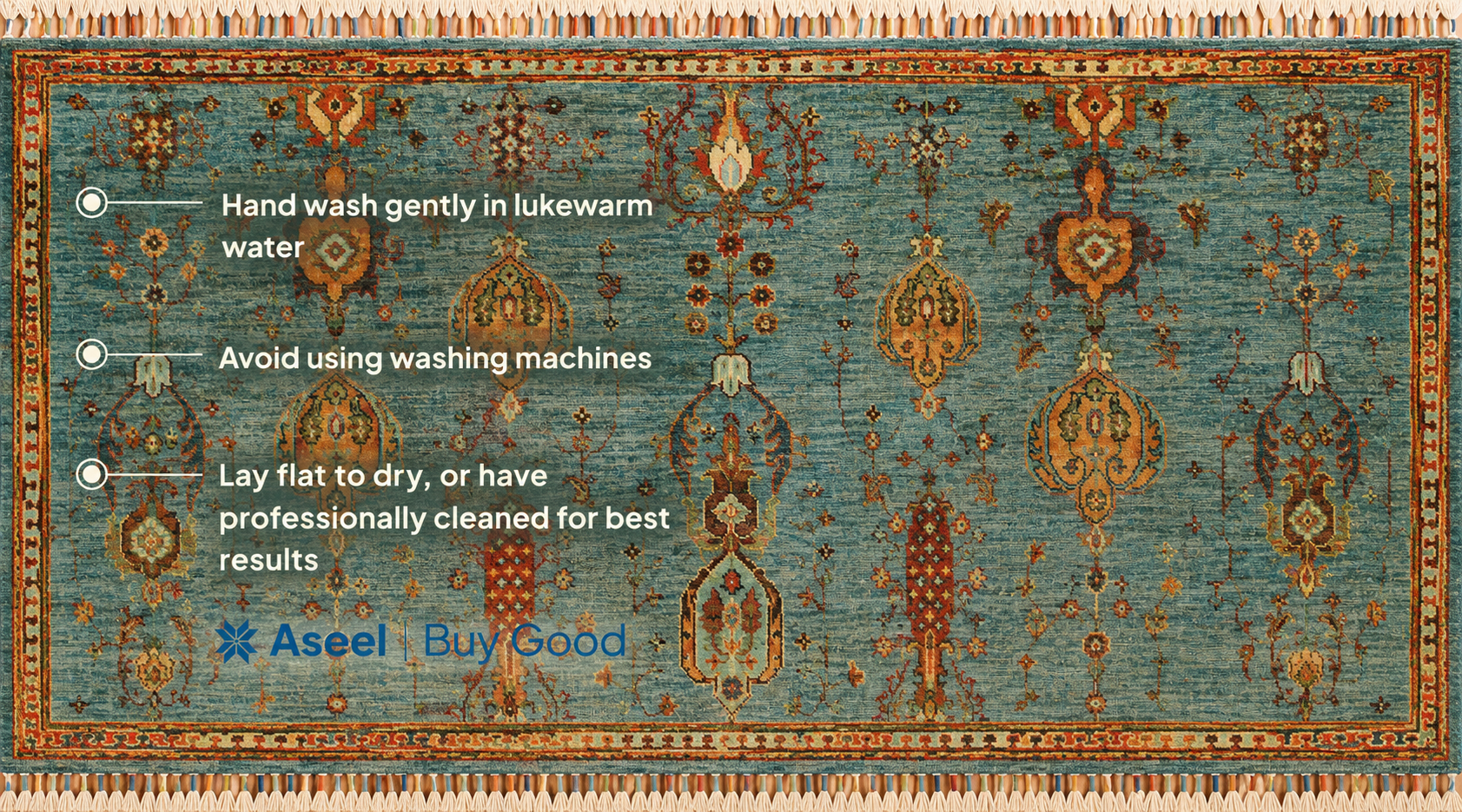
Professional cleaning every three to five years by a specialist who understands hand-knotted wool construction is the most important maintenance action. Avoid steam cleaning and wet shampoo methods that can damage the wool foundation. Rotate the rug 180 degrees every year or two to equalize foot traffic and sunlight exposure. Use a quality rug pad to prevent slipping and reduce pile wear. Keep the rug away from sustained direct sunlight.
Should I get an appraisal for my Afghan rug?
Yes — for any piece valued above $3,000, a professional appraisal from a credentialed textile appraiser is worthwhile. For insurance purposes, an appraisal document ensures replacement value is accurately established. For investment purposes, periodic appraisals document the appreciation trajectory and support premium pricing in any eventual sale.
What is a realistic budget for an investment-quality Afghan rug?
Entry-level investment-grade pieces in smaller sizes (4 by 6 or 5 by 8 feet) begin around $1,500 to $3,000 from reputable sources. Mid-scale investment pieces in room sizes (8 by 10 or 9 by 12 feet) of genuine quality typically run $4,000 to $12,000. Exceptional pieces — large sizes, extraordinary knot density, outstanding condition, documented provenance — command $15,000 and above.
Can Afghan rugs work in a contemporary all-white interior?
Exceptionally well. In an all-white or near-white interior, an Afghan rug functions as the room's entire color story. The contrast between the white background and the rug's warm tones is dramatic and highly effective — one of the most visually sophisticated placements possible, provided the rug itself is of sufficient quality to carry the visual weight of being the room's defining element.
How long does a hand-knotted Afghan rug last? A hand-knotted Afghan rug made from quality high-altitude wool with a sound foundation can last 100 to 200 years with proper care — outlasting multiple generations of owners and multiple evolutions of interior fashion. The wool fibers used in fine Afghan production are among the most durable natural textile materials available, and the knotted construction distributes wear so evenly that structural integrity is maintained long after the pile has developed the low, lustrous quality that collectors call fine patina.

Afghan Handmade Wool Rug – Teal Floral Persian Bokhara Style Area Rug
Shop this authentic Afghan handmade wool rug featuring a classic teal & rust floral Bokhara design with hand-knotted fringe. Perfect for living rooms. Free shipping.
About Aseel
Aseel is a tech-driven startup providing a digital marketplace where artisans can sell their one-of-a-kind handcrafted products while supporting humanitarian efforts worldwide. We champion using practical skills to create the positive impact businesses and communities deserve. Aseel's intuitive platform empowers thousands of makers by connecting them with a global audience. Transparency and privacy are at the heart of everything we do. Our dedicated customer service team is available anytime to assist clients through our secure and protected platform.