Afghanistan’s Children Cannot Wait: Why We Are Launching a Child Malnutrition Emergency Campaign

Jul 26, 2026
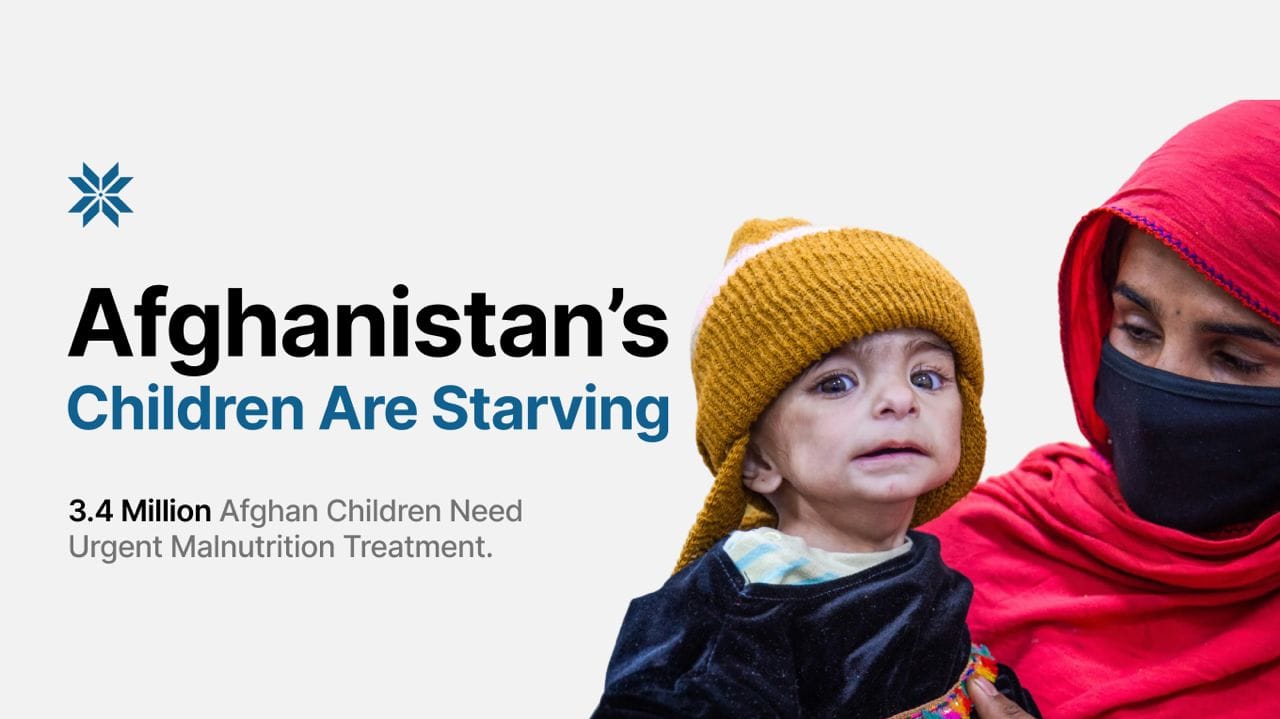
Right now, Afghanistan is living through one of the worst child malnutrition crises in the world. In clinics, camps, and border reception points, you see the same picture again and again: children with thin arms, tired eyes, and mothers who have already run out of ways to stretch a piece of bread.
The problem we are facing
Recent assessments warn that around 3.5 million children under five in Afghanistan are suffering or expected to suffer from acute malnutrition between 2025 and 2026. Close to a million of them are in severe, life-threatening forms of wasting. At the same time, more than one million pregnant and breastfeeding women are expected to be acutely malnourished.

Behind every figure is a family forced into impossible choices. Many households survive on one poor-quality meal a day. Protein, fruit, and vegetables have become luxuries. When a child finally reaches a clinic, the staff can stabilize them, but once they go back home, there is often nothing to keep them from falling back into hunger.

On top of this deep, long crisis, a new shock has hit. Since late 2023, more than four million Afghans have returned from Iran and Pakistan, many of them through forced or pressured returns. In 2025 alone, over one and a half million people have been pushed back into a country whose economy has collapsed and where nine out of ten families are already skipping meals or going into debt just to eat.
Many of the returnees are children who were born in Pakistan or Iran and have never seen Afghanistan before. They arrive with almost nothing and are sent to overcrowded camps or informal settlements where food is already scarce. Each bus that crosses the border is not only bringing people home. It is bringing new cases of child malnutrition into a system that is already overwhelmed.
Why are we launching this campaign now?

When thousands of children are on the edge of severe undernutrition, timing becomes as important as funding. Malnutrition in early childhood does not wait. It weakens immunity, stunts growth, and blocks brain development. A delay of a few weeks can mean the difference between a child who recovers and a child who carries the damage for life, or does not survive at all.
We are launching the Child Malnutrition Emergency Campaign now because several realities are colliding at the same time:
--> Record numbers of children are acutely malnourished.
--> Mass deportations from Iran and Pakistan are adding millions of vulnerable people to an already fragile situation.
--> International funding for Afghanistan has fallen, even as needs have grown.
--> Local health facilities are doing their best, but they cannot solve the food crisis outside their doors.
This campaign is about closing the gap between treatment and survival. It is about ensuring that when a child leaves a clinic or arrives at a border camp, there is a concrete, reliable line of support that delivers food to that family quickly and consistently.
How Aseel helps on the ground
Aseel started as a platform to connect Afghan artisans with buyers around the world. When Afghanistan’s crisis deepened, it transformed that same digital backbone into a practical lifeline for humanitarian aid.
Since 2020, Aseel and its partners have supported more than 600,000 people with food, winter items, hygiene kits, and other essentials. The AidOS system links donations directly to local vendors, coordinates orders, and tracks distributions in real time, even in hard-to-reach areas. This means less bureaucracy, less waste, and more speed.
For this Child Malnutrition Emergency Campaign, Aseel will:
--> Work with local teams to identify children and mothers at highest risk, especially among recent returnees and families in informal settlements.
--> Provide targeted food and nutrition packages that complement clinical treatment and support both the child and the mother at home.
--> Use the existing app and website so that anyone can fund a package, follow the impact, and even launch a small challenge or fundraiser in their own network.
Aseel has already run dedicated campaigns for food kits for malnourished children, winter packages for deported families, and direct aid to camps hosting returnees. The structure exists. The teams and vendors are in place. What is needed now is the scale.
Why your support matters
It is easy to feel helpless when you hear about Afghanistan. The politics are complicated. The news cycle is exhausting. Many people feel they have already given so much.
Child malnutrition cuts through all of that. A two-year-old does not choose borders, governments, or deportation orders. They only know if they are hungry and whether someone shows up to help.
Supporting this campaign means:
--> Turning statistics into actual food on an actual mat in a tent or a bare room.
--> Giving mothers who have been pushed across borders at least one thing they can count on.
--> Buying time for children whose bodies and brains are still developing and cannot wait for a better political moment.
The truth is simple. Afghanistan’s children did not create this crisis. They should not be the ones who pay the highest price for it.
If we act now, with focus and urgency, we can keep thousands of them from sliding into severe malnutrition and give families at least one solid pillar in a very uncertain life. That is what this campaign is about.
About Aseel
Aseel is a tech-driven startup providing a digital marketplace where artisans can sell their one-of-a-kind handcrafted products while supporting humanitarian efforts worldwide. We champion using practical skills to create the positive impact businesses and communities deserve. Aseel's intuitive platform empowers thousands of makers by connecting them with a global audience. Transparency and privacy are at the heart of everything we do. Our dedicated customer service team is available anytime to assist clients through our secure and protected platform.