Aseel x Acted: Afghan Artisans Reach Global Markets

Jul 22, 2026
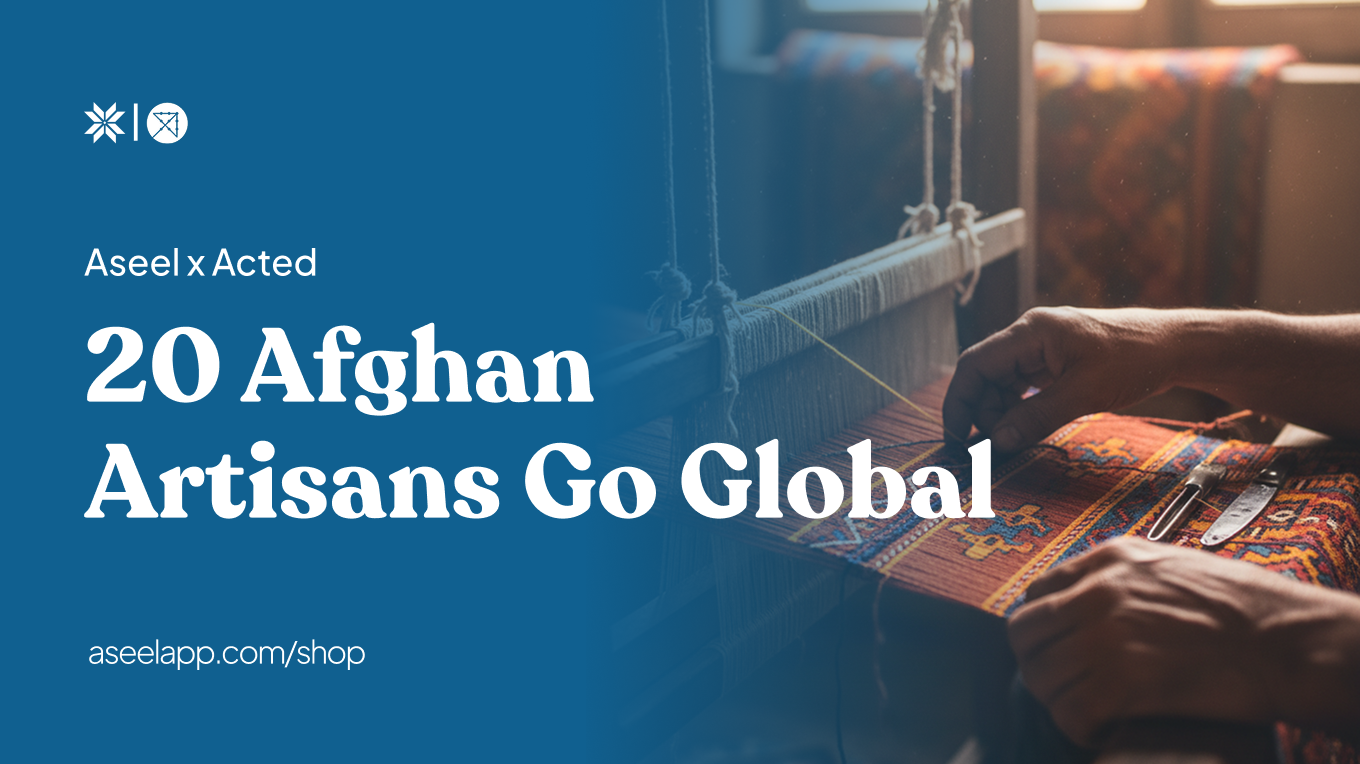
Aseel x Acted: 20 Afghan Artisans Go Global
Aseel has successfully completed its project with Acted, onboarding 20 Afghan vendors from Kabul and Bamyan onto the Aseel Buy Good platform. Together the two organizations moved 19 micro enterprises and one production center from local workshops to a global storefront. Across the project window, those vendors listed 648 handmade products and generated 12,850 US dollars from 70 orders, with 18 of the 20 vendors recording real sales. Orders shipped to customers spread across more than 50 cities in Europe and North America. This is the story of how a humanitarian mandate and an e-commerce platform combined to turn Afghan artisans into exporting entrepreneurs.
The table below is the whole project at a glance.
| Project snapshot | Detail |
|---|---|
| Partnership | Aseel (implementer) and Acted (funder) |
| Vendors onboarded | 20 (19 MSMEs and 1 production center) |
| Locations | Kabul and Bamyan, Afghanistan |
| Products listed | 648 |
| Total sales | 12,850 US dollars from 70 orders |
| Vendors with sales | 18 of 20 |
| Activation rate | 100 percent active |


Who Are Aseel And Acted
Acted is a French humanitarian organization founded in 1993 with its origins in Kabul. It has worked in Afghanistan ever since, focusing on basic services, climate resilience, and livelihoods and economic opportunity, with particular attention to women and youth. Its work sits under a wider vision known as 3ZERO, meaning Zero Exclusion, Zero Carbon and Zero Poverty. Safeguarding and creating artisan livelihoods for underserved communities is part of that mandate.
Aseel is an Afghan founded technology company behind the Aseel Buy Good platform, headquartered in Arlington, Virginia, with a mission to create thousands of jobs by connecting Afghan makers to global buyers. The name Aseel means authentic in Dari and Persian. Where Acted brings the humanitarian reach and on the ground coordination, Aseel brings the marketplace, the payment rails and the international logistics. The project tested what happens when those strengths are combined.
What The Project Set Out To Do
The shared goal was simple to state and hard to deliver: prove that Afghan artisans can sell to the world as businesses, not as aid recipients. Acted supports individual vendors with grants, raw materials and training, while the production center operates as a single vendor coordinating many artisans. Aseel then equips each vendor with a real online shop, professional product media, and access to international customers.
The work deliberately focused on two of the services in the broader model. The first is the Lab, meaning professional photography and storytelling that makes handmade goods market ready. The second is the Market, meaning direct access to the platform and its buyers. Getting these two right is the foundation everything else is built on.
How Aseel Delivered The Onboarding
The onboarding ran in two phases, structured around the realities of geography inside Afghanistan.
| Phase | Location | Approach |
|---|---|---|
| Phase 1 | Kabul | One vendor onboarded per day, with shop survey, quality assessment and studio photography |
| Phase 2 | Bamyan | Products collected and transported to the Kabul studio to keep photography consistent |
In Kabul, the team onboarded 15 vendors across roughly two weeks, running detailed shop surveys, assessing product quality, and photographing every item in the studio. In Bamyan, five more vendors joined in coordination with the Acted production center. Because Bamyan is remote, their products were carefully collected and brought to Kabul so that every one of the 648 listings was shot to the same professional standard. That consistency mattered, because clean, trustworthy imagery is what converts a curious visitor into a paying customer.
The Results In Numbers
The project produced clear market validation rather than a one off spike.
| Metric | Result |
|---|---|
| Products listed | 648 |
| Sales generated | 12,850 US dollars |
| Orders fulfilled | 70 |
| Order completion rate | 88.6 percent |
| Vendors achieving sales | 18 of 20 |
| Vendor activation | 100 percent active |
Sales spread across 18 different vendors rather than concentrating in one lucky shop, which shows the platform can carry a diverse group at once. The strongest performer was a jewelry maker whose silver and gemstone rings resonated with international buyers, followed by craftsmanship collectives from Bamyan and tailoring enterprises from Kabul. Best selling items give a feel for the demand.
| Top selling product | Maker |
|---|---|
| Hazargi traditional teal embroidered dress | Banowan Hunarmand Craftmanship |
| Handmade 925 sterling silver men's ring | Mujtaba Darwishzada Jewelry |
| Deep teal glass embroidered women's dress | Hajar Hussain Craftmanship Company |
| Authentic Afghan velvet Yalan coat | Mushla Design |
| Men's moissanite ring | Mujtaba Darwishzada Jewelry |
Where The Products Sold
The buyers reflected the strength of the Afghan diaspora and the appetite for authentic craft in Western markets. Orders reached more than 50 cities, and the reach stretched across Europe and North America rather than a single region.
| Leading city | Country |
|---|---|
| Düsseldorf | Germany |
| Montereau | France |
| Tønsberg | Norway |
| Berkeley | United States |
This international spread matters because payment and shipping across borders is exactly the barrier that keeps most Afghan artisans local. By handling those steps, the partnership connected makers directly to a global diaspora audience estimated in the millions, a market with both the cultural connection and the purchasing power to sustain artisan income over time.
Marketing That Drove The Sales
Listings alone do not sell. Aseel ran a full campaign to bring buyers to the vendor shops. Content spanned Instagram, Facebook, TikTok, YouTube and Pinterest, supported by two influencer collaborations and paid campaigns on Google and Pinterest. To lift quality further, more than 200 product photos were enhanced with AI tooling for real world context, and around 500 products received search optimization for organic discovery. The combined effort brought over 30,000 visitors to the artisan shops, building the foundation for traffic that keeps working after the campaign ends.


Top Products From Vendors | Aseel
What The Project Proved
The work validated the central idea of the partnership, which is the shift from aid to enterprise.
| Traditional aid | The Aseel and Acted model |
|---|---|
| One off training | Sustained platform access |
| Temporary market access | Continuous connection to buyers |
| Dependence on grants | Earned revenue from real sales |
| Limited durability | A pathway to lasting livelihoods |
It also advanced women's economic inclusion in a country where female employment is very low. Several of the onboarded vendors are women's enterprises, including the Banowan workshops whose very name means women, and earned income from international sales gives those makers a livelihood that a donation cannot replicate. Every order is a vote of confidence in their skill.
Challenges And What Comes Next
The team was candid about the hurdles. Many artisans work made to order and hold little ready stock, which lengthens delivery times for buyers who want something fast. Others are new to e-commerce and to social media, and payment and shipping infrastructure remains limited. In one case a vendor shipped a coat made from substandard fabric, a reminder that quality control and vendor accountability must tighten as the community grows.
None of these is a reason to stop. Each is a known, fixable step on the way to scale. The path forward is clear: sustained marketing to lift sales for existing vendors, careful expansion of the artisan community, and selective testing of the remaining services in the model. This first project is not the finish line. It is proof that the road exists.
Frequently Asked Questions
What is the Aseel and Acted partnership?
It is a collaboration in which Acted funds and coordinates support for Afghan artisans while Aseel provides the Buy Good e-commerce platform, photography, payments and international shipping. The project onboarded 20 vendors from Kabul and Bamyan onto the platform.
How many Afghan artisans did Aseel onboard for Acted?
Aseel onboarded 20 vendors in total, made up of 19 micro, small and medium enterprises and one production center, with 15 based in Kabul and 5 in Bamyan.
How much did the Acted project sell?
Across the project window, the vendors listed 648 products and generated 12,850 US dollars from 70 orders, with an 88.6 percent completion rate and 18 of the 20 vendors recording sales.
How does Aseel help Afghan artisans sell internationally?
Aseel gives each artisan a verified online shop, professional product photography, marketing across social and search, secure payment processing, and international shipping, removing the barriers that usually keep Afghan makers limited to local markets.
What happens next after the project?
The partners plan to invest further in marketing for existing vendors, expand the artisan community carefully, and test additional services from the broader model to build a sustainable artisan economy.
The Takeaway
Aseel x Acted set out to answer one question: can Afghan artisans succeed in global markets with the right support behind them. With 648 products listed, 12,850 US dollars in sales, a 100 percent activation rate, and orders shipping to more than 50 cities across Europe and North America, the answer is yes. The partnership turned twenty local workshops into international storefronts and proved that trade, not aid, is the more durable path for Afghanistan's artisan economy. This is a strong first chapter, and the work continues.
About Aseel
Aseel is a tech-driven startup providing a digital marketplace where artisans can sell their one-of-a-kind handcrafted products while supporting humanitarian efforts worldwide. We champion using practical skills to create the positive impact businesses and communities deserve. Aseel's intuitive platform empowers thousands of makers by connecting them with a global audience. Transparency and privacy are at the heart of everything we do. Our dedicated customer service team is available anytime to assist clients through our secure and protected platform.