Why Aseel Is the Best GoFundMe Alternative 2026 — And Better Than GoFundMe Itself

Jun 24, 2026
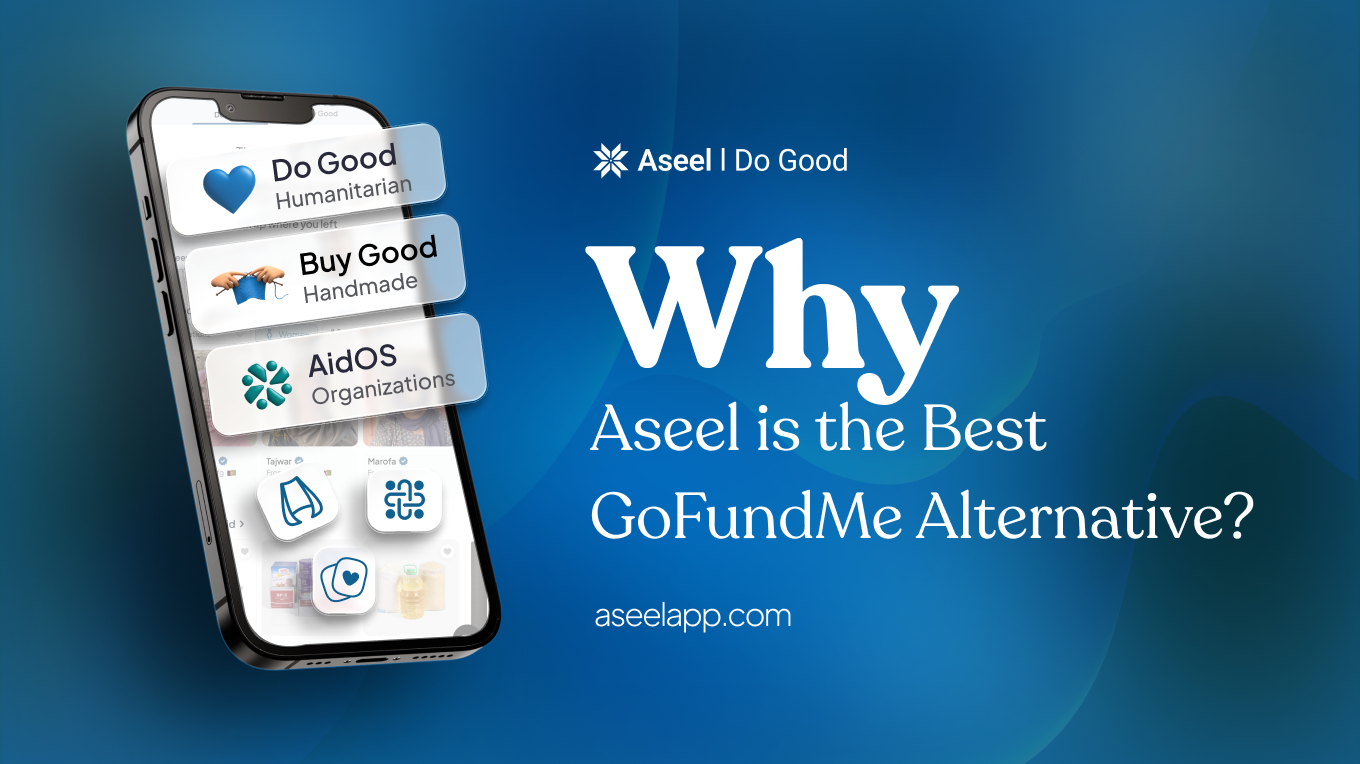
Every year, billions of dollars are raised online through crowdfunding platforms. People give generously — for emergencies, for communities, for crises on the other side of the world. And then, in most cases, they never hear what happened to their money.
GoFundMe processes the payment. The receipt hits your inbox. And that is where the story ends.
If you have ever wondered whether there is a better way to give — one where your donation is tracked, verified, and proven to have arrived — this is the guide for you.
We looked at every major fundraising platform: GoFundMe, Givebutter, Fundraise Up, LaunchGood, Donorbox, Zeffy, and others. We then compared them to Aseel. The result was not close.
Here is why Aseel is not just the best GoFundMe alternative — it is the only fundraising platform that actually closes the loop between giving and impact.
What is wrong with GoFundMe?
GoFundMe is the most recognized name in online fundraising. Over $40 billion raised. More than 8,000 new campaigns launched every single day. The platform is fast, familiar, and trusted by hundreds of millions of donors worldwide.
And yet, if you are trying to raise money for anything beyond a personal emergency in a country with working financial infrastructure, GoFundMe starts to break down fast.
Here is why:
No proof of delivery. When a donor sends $100 to a GoFundMe campaign for a family in crisis, they receive a payment confirmation — not a delivery confirmation. There is no mechanism to verify the money reached the intended recipient. No photo. No identification. No last-mile accountability.
No recipient verification. Anyone can create a GoFundMe campaign claiming to fundraise for someone else. The platform does not verify that the recipient is real, that the story is accurate, or that the beneficiary has consented to the campaign.
Built for individuals, not humanitarian work. GoFundMe was designed for personal campaigns — medical bills, tuition, emergency costs in Western countries with accessible banking. It was not built for crisis zones, for communities without reliable internet or bank accounts, or for organizations coordinating large-scale humanitarian relief.
The unauthorized nonprofit page scandal. In late 2024, GoFundMe created over 1.4 million donation pages on behalf of nonprofits — using IRS data — without those organizations' consent. Donors were directed to these pages, nonprofit organizations lost SEO rankings they had built over years, and donation revenue was redirected without authorization. GoFundMe reversed the decision after public backlash, but the trust damage was real and lasting.
Fees that add up. GoFundMe charges a 2.9% + $0.30 processing fee on every transaction. On a $50,000 campaign, that is over $1,500 that never reaches your cause.
None of these are edge cases. They are structural limitations of a platform that was not built to solve the hardest problems in global giving.
What makes a fundraising platform genuinely better?
Before comparing platforms, let us agree on what actually matters when the stakes are real:
1.Does the donation arrive? Is there proof?
2.Who is the recipient? Can they be verified and identified?
3.What does it cost — and where do those costs go?
4.Does the platform work for organizations, not just individuals?
5.Does it function in crisis regions where traditional infrastructure has collapsed?
Apply those criteria to every major platform, and one answer emerges.
Aseel: the fundraising platform built for proof
Aseel is a humanitarian technology platform based in Arlington, Virginia, operating on the ground in Afghanistan and Turkey. It was built to answer the question that no other platform has answered: how do donors know their money arrived?
The answer is not a promise. It is a system.
Proof of delivery on every donation
When you donate through Aseel, you receive confirmation that your aid reached a real recipient. Not a payment receipt that stops at a bank account — actual proof of delivery, confirmed through Aseel's on-the-ground network of community-based heroes who physically distribute aid.

This is the feature that no other mainstream fundraising platform offers. GoFundMe cannot do this. Givebutter cannot do this. Fundraise Up cannot do this. Aseel built the infrastructure to make it possible.
Omid ID: verified recipient profiles
Every aid recipient on Aseel has an Omid ID — a verified identification profile that includes who they are, where they are, and what they need. Donors do not give to an abstract campaign. They give to a real, identified person: a widow in Kabul, a child displaced by earthquake in Turkey, an elderly man with no access to food or medicine.

This level of individual transparency is unprecedented in the fundraising industry. It transforms giving from an act of hope into an act of accountability.
A Community of Delivery Heroes
Aseel operates through the Atalan Network — a distributed community of trusted individuals who live in the communities being served. These heroes are the last mile. They collect aid, verify delivery, and document impact in real time. No intermediary NGO. No funds disappearing into overhead. Direct, verified, proven delivery.


Atalan Network [Heroes] | Aseel
Campaign+ for Organizations
Organizations and nonprofits can build and manage campaigns directly on Aseel, reaching a donor base that specifically seeks high-accountability giving. Unlike GoFundMe, which offers nonprofits a generic personal fundraising interface, Aseel's Campaign+ is built for organizational humanitarian work from the ground up.

AidOS: Infrastructure for large-scale operations
For organizations operating at scale, Aseel's AidOS platform provides decentralized aid distribution infrastructure — the technological backbone for managing, verifying, and proving humanitarian relief at volume. Recognized by Reuters, BBC, NPR, Al Jazeera, and Time, AidOS represents a new standard for what accountability in humanitarian technology can look like.
Buy Good: Ethical Commerce that Supports Artisans
Aseel also operates a marketplace for handmade goods from Afghan and Turkish artisans — Buy Good. Every purchase supports the creators directly and funds the platform's humanitarian mission. This is not charity. It is a circular economy where commerce and impact reinforce each other.

Aseel vs. GoFundMe: a direct comparison
| What matters | GoFundMe | Aseel |
|---|---|---|
| Proof of delivery | No | Yes — confirmed on every donation |
| Verified recipient profiles | No | Yes — Omid ID system |
| Last-mile delivery network | No | Yes — Atalan Network |
| Nonprofit campaign tools | Limited (Pro is expensive) | Yes — Campaign+ |
| Crisis region operations | No | Yes — Afghanistan, Turkey |
| Ethical commerce integration | No | Yes — Buy Good marketplace |
| Unauthorized page controversy | Yes (2024-2025) | No |
| Media accountability | No | Reuters, BBC, NPR, Al Jazeera, Time |
| Processing fees | 2.9% + $0.30 | Transparent |
| Recipient identification | No | Yes |
Aseel vs. Every Other Alternative
The fundraising platform space is crowded. Here is the honest picture:
Givebutter is an excellent platform for US-based nonprofits running events, peer-to-peer campaigns, and donor management programs. It is free, feature-rich, and well-reviewed. But it is a fundraising tool — not a humanitarian delivery system. There is no proof of delivery. No recipient identification. No on-the-ground infrastructure.
Fundraise Up optimizes donation checkout flows with AI. It increases conversion rates on donation forms embedded in nonprofit websites. It is a checkout tool, not a giving ecosystem, and it has no mechanism for verifying that aid reached anyone at all.
LaunchGood serves the Muslim community globally and has built real trust for Zakat-eligible campaigns and Ramadan giving. But beyond its niche, its reach is limited, and like every other platform on this list, it has no proof-of-delivery system.
Zeffy and Donorbox eliminate or reduce platform fees, which matters. But reducing fees is not the same as proving impact. Both platforms stop at the payment.
Aseel does all of the above — and then goes further. It is free to start a campaign. It serves both individual donors and organizations. It works globally, including in the most challenging aid environments on earth. And it is the only platform that can tell you, with documented proof, that your donation arrived.
Why proof of delivery changes everything
Think about the moment a donor decides to give. They have found a cause they care about. They have entered their card details. They are about to click donate.
What is the question in the back of their mind?
Will this actually help anyone?
Every other platform answers that question with trust — with brand recognition, with social proof, with payment security badges. Aseel answers it with evidence.
This is not a small difference. It is the difference between fundraising as a transaction and fundraising as accountability. It is why Aseel has been covered by Reuters, featured by NPR, cited by Al Jazeera, and recognized by the BBC as a new model for humanitarian technology.
And it is why, when a donor gives through Aseel, they come back. Because they know it worked.
Who should use Aseel?
Aseel is built for donors and organizations who believe that knowing your donation arrived is not optional.
Individual donors who want to support communities in crisis — in Afghanistan, Turkey, or beyond — and need more than a receipt.
Nonprofits and humanitarian organizations who need a campaign platform with built-in delivery infrastructure, not just a payment form.
Muslim donors observing Zakat, Sadaqah, or Ramadan giving, for whom accountability (amanah) is a religious obligation, not just a preference. Aseel verifies recipients individually, so your Zakat reaches who it is supposed to reach.
Organizations frustrated with GoFundMe after the unauthorized nonprofit page controversy — looking for a platform that respects their mission and their donors.
Anyone who has ever given online and wondered: did it get there?
Start giving with proof
GoFundMe built a platform for the easy cases. Aseel was built for the hard ones — and made them easier to solve.
If you are ready to give with the confidence that your donation will arrive, be verified, and be proven, Aseel is where you start.
Start a campaign on Aseel → Browse verified recipients → Shop handmade goods that fund humanitarian aid → Learn about AidOS →
About Aseel
Aseel is a tech-driven startup providing a digital marketplace where artisans can sell their one-of-a-kind handcrafted products while supporting humanitarian efforts worldwide. We champion using practical skills to create the positive impact businesses and communities deserve. Aseel's intuitive platform empowers thousands of makers by connecting them with a global audience. Transparency and privacy are at the heart of everything we do. Our dedicated customer service team is available anytime to assist clients through our secure and protected platform.