Herati Glass: Afghanistan's Last Glassblowers

Sep 03, 2026
Herati Glass: Inside Afghanistan's Last Glassblowing Workshops
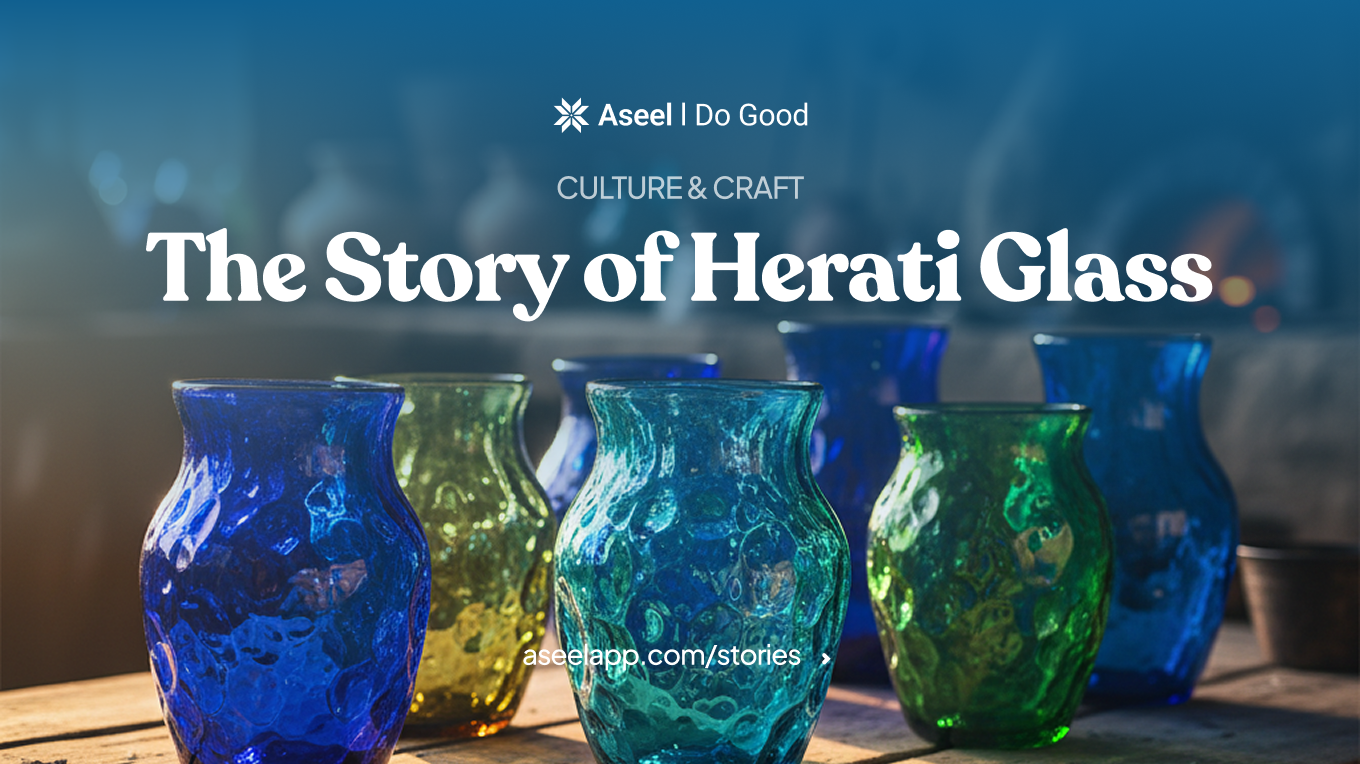
If you have held a piece of Herati glass, you will remember it. The colour is uneven. There are bubbles trapped in the wall. The rim is slightly out of true. Those are not flaws in the manufacturing sense. They are the fingerprints of a process that involves one furnace, one blowpipe, and a small number of men in Herat who still know how to do this.
This article sets out what is actually documented about that craft, what the sources disagree about, and what you should look for if you want to buy a piece. Where the evidence is thin, it says so. That matters more than usual here, because a lot of what is written about Herati glass online cannot be traced to any source at all.
What is Herati glass?
Herati glass is hand-blown glassware made in Herat, in western Afghanistan, using a wood-fired furnace, an iron blowpipe, and no machinery. It is recognisable by its strong colours, most often turquoise, deep blue, and green, and by the visible irregularities that come from shaping molten glass by breath and hand.
The scale of production is very small. According to reporting by AFP in August 2024, two furnaces remained in use: one inside the family home, one in a mud-and-straw structure near Herat's citadel. The work is carried out by a single extended family.


How Herati glass is made
The traditional recipe
The Corning Museum of Glass, which has documented this craft directly, recorded the traditional batch as two ingredients: white pebbles gathered from riverbeds, which supply the silica, and the ash of a desert plant known locally as ishkar or ishgar, which supplies the alkali that lets the mixture melt at a workable temperature.
There is a detail here worth keeping. According to Turquoise Mountain's account, glassmakers historically judged the quality of ishkar by taste, and the sweeter it tasted, the better it was considered. The same plant ash was used in Afghanistan for making soap and for pottery glazes, which is why you will also encounter it in accounts of Istalif's turquoise ceramics.


Beautiful Herati Glassware on Display
What is used today
Most contemporary Herati glass is not made from quartz and plant ash. It is made from recycled glass. AFP reported in 2018 that makers work from recycled bottles and broken window glass, simply because that material is easier to find.
This is usually presented by sellers as an environmental choice. The honest version is less flattering and more interesting: the shift to recycled cullet was driven by economics and availability, not by eco-design. The glass is genuinely recycled. The reason it is recycled is that the traditional supply chain became impractical.
Colour
Colour comes from metal oxides added to the melt. AFP recorded copper and iron powder being mixed into the glass to produce blue and green tints. Some colours are also achieved by melting down coloured glass bought in the bazaar rather than by adding oxide directly.
The palette that reaches the market is narrow and consistent: turquoise, azure, lapis or indigo blue, green, and amber or gold. Retailers generally use those colour names as their product variants.
The furnace and the blow
The furnace is a mud-brick or stone structure daubed with clay, fired with wood. Corning's field account describes a furnace nearly two metres long, built from local stones daubed with clay and mud, with the batch melted in mud-brick crucibles set above the firing chamber.
Working temperature is reported inconsistently. Several accounts put it above 1,200 degrees Celsius; ABC News reported an oven core temperature of 2,000 degrees Fahrenheit, which is closer to 1,090 degrees Celsius. Treating it as roughly 1,100 to 1,200 degrees Celsius is the defensible reading.
From there the sequence is the one glassblowers have used for two thousand years anywhere in the world. The maker gathers molten glass on the end of a long iron pipe, blows air through it to inflate a bubble (a parison), then rolls that bubble on a flat steel slab (a marver) to cool and shape it before finishing with simple hand tools.
According to the International Folk Art Market, which has hosted the family in Santa Fe several times since 2014, the labour is divided by gender: men shape the glass, women decorate finished pieces. You will occasionally see a retailer claim the glass itself is blown by women. Every journalistic and institutional account describes male glassblowers, so treat that claim with caution.
How old is glassmaking in Herat?
This is where most published accounts go wrong, and it is worth being direct about it. You will find pages asserting that Herati glass is 2,000 years old, and other pages asserting 3,000 years. Those two claims contradict each other, neither carries a citation, and no museum, university or archaeological source supports a continuous glassmaking tradition in Herat of either length. Reliable evidence was not found for any specific origin date.
What can be documented is narrower and more interesting.
First, the technique closely parallels the oldest surviving written glass recipes, which are Assyrian cuneiform tablets from roughly the 7th century BC. Corning makes this comparison, and so does Turquoise Mountain. Read carefully, that is a statement about the resemblance between Herati practice and ancient Mesopotamian practice. It is not evidence that Herat was making glass in the 7th century BC.
Second, there is a scholarly trace. Encyclopaedia Iranica's entry on glass compares a Sasanian-period glass furnace excavated at Takht-e Solayman to "a traditional style glassworks in modern Afghanistan," citing Marguerite Reut's 1973 study Le verre soufflé de Hérat. The same entry is candid that the wider picture is unresolved, noting that further research is needed to establish whether Khorasan was in fact a major glass-producing centre in that period.
Third, the family's own lineage is documented and substantial. Corning's account records a family that had been making glass for about 200 years. Roads and Kingdoms reported eight generations. Turquoise Mountain notes that by the 1960s the industry had shrunk to several small factories, one of them run by a family that had been making glass for two hundred years.
Two hundred years of unbroken family practice is a real and remarkable thing. It does not need to be inflated to three thousand.
Who still makes it
Naming the makers is harder than it should be, because the sources do not agree.
The surname recorded by the International Folk Art Market is Faizi: Nasrullah Faizi represented the family in 2014 and 2015, Khairullah Faizi in 2023 and 2024, and Obaidullah Faizi in 2025. AFP, reporting in 2024, named the working master as Ghulam Sakhi Saifi, then around 50, working with his 18-year-old son Naqibullah. Roads and Kingdoms in 2018 named Gholam Sakhi, then 45, and his son Habibullah, then 18, and recorded that Gholam Sakhi began learning at seven and his son at five.
The relationships between these men are described differently by different outlets: brothers in one account, cousins in another, uncle and nephew in a third. Rather than pick one, the accurate summary is this: one extended family in Herat, variously reported as brothers, cousins and nephews, holds this craft.
Corning's 2013 account names cousins Saifullah and Saidullah and a nephew, Nasrullah. Robert H. Brill, the Corning research scientist who conducted fieldwork in Herat in the 1970s, later hosted a member of the same family at the museum, described at the time as the last glassmaker still working in Afghanistan.
That 1970s fieldwork produced a documentary film, The Glassmakers of Herat, which is the single best primary record of the craft. Even its date is contested: Corning dates it 1977, while the library catalogue at UC Berkeley's BAMPFA records it as produced and directed by Elliott Erwitt with narration by Brill, 27 minutes, distributed by Benchmark Films, copyright 1979, released 1982.
How many workshops are left? A documented timeline
No single figure answers this, because the number has changed and different reporters counted different things. Here is every documented data point, in order.
| When | What was reported | Source |
|---|---|---|
| 1960s | Several small factories, one run by a 200-year family | Turquoise Mountain |
| Recalled from the 1970s | 12 factories, when tourists came in numbers | Hajji Sultan, quoted by Ishkar |
| 2016 | "Now 1 factory" | Hajji Sultan, quoted by Ishkar |
| July 2018 | Three traditional glassblowers remaining in Afghanistan | ABC News |
| 2018 | Two active glassblowers remaining in Herat | Roads and Kingdoms |
| August 2024 | Two furnaces in use, one extended family | AFP |
| December 2025 | 500 decorated pieces reported exported to Europe and the US | Pajhwok Afghan News |
| January 2026 | The family reported to be training its first apprentices | tuenews |
Two things stand out. The first is that the decline is real and well documented. The second is that the story does not end where most articles leave it. The most recent reporting describes exports resuming and apprentices being trained, which is the opposite of an ending.
The causes of the decline are consistent across every source: cheap factory-made imports, the collapse of tourism, decades of war, the loss of international customers after 2021, and the pandemic. As Ghulam Sakhi told AFP in 2024: "This is our art, our inheritance. If we do not pass it down, it will disappear from the whole world."
Is Herati glass protected heritage?
No, and this is worth knowing because it is frequently assumed.
Afghanistan ratified the UNESCO Convention for the Safeguarding of the Intangible Cultural Heritage on 30 March 2009. As of this writing it has five inscribed elements on the Representative List: Behzad's style of miniature art (2025), Nawrouz (2024), the rubab (2024), Yaldā or Chella (2022), and sericulture and traditional silk production (2022). You can verify this on UNESCO's Afghanistan country page.
Herati glassmaking is not on any UNESCO list. Given that it is arguably the most endangered of Afghanistan's surviving crafts, that absence is striking.
Who has worked to keep the craft alive
Support has come from a scattered set of organisations, and no single page has previously connected them.
-> Corning Museum of Glass documented the craft through Robert Brill's fieldwork and the 1970s film, and later hosted a family member at the museum.
-> The Aga Khan Foundation is reported to have financed a glass workshop near Herat's Masjid-i Jami by 1997.
-> Turquoise Mountain has brought Herati glass to international retail.
-> Kitengela Hot Glass in Kenya hosted Herati glassblowers for training in October 2019 and January 2020, supported by the United Nations International Trade Centre and the European Union, building a Herat-style furnace at the Kenyan studio in the process.
-> The International Folk Art Market in Santa Fe has hosted family members repeatedly between 2014 and 2025.
-> A German import route was built by the journalist Wolfgang Bauer, with a first shipment in 2023 and a further delivery of 40 crates in November 2023. According to reporting in January 2026, revenue from that channel is funding the family's first apprentices.
What to look for when buying Herati glass
How to tell genuine Herati glass from generic recycled glassware
There is a large global market in recycled-glass tumblers, most of it produced in Mexico, India and Spain. Those pieces are often lovely and often cheaper. They are not Herati glass. No seller currently publishes guidance on telling them apart, so here is what the documented characteristics actually give you:
-> Ask where it was blown, not where it was designed. A genuine piece was blown in Herat. If a seller cannot name the workshop or the family, that is a meaningful gap given how few makers exist.
-> Expect irregularity. Uneven wall thickness, trapped bubbles, a rim that is not perfectly level, and colour that varies within a single piece are all consistent with hand-blowing in a wood-fired furnace. Perfect uniformity across a set suggests machine production.
-> Expect the palette. Turquoise, azure, lapis, green, amber. A piece in an unusual colour is not automatically inauthentic, but the documented range is narrow.
-> Check the object type. The documented output is tumblers, two-tone goblets, shot and tea glasses, carafes, jugs, vases, bowls and candle holders.
Do not confuse Herati glass with "Afghan Roman glass"
Search for "Afghan glass" and you will meet a completely separate category: excavated ancient glass beads sold as "Roman glass," often set into jewellery. These are archaeological or antique bead products. They have nothing to do with contemporary hand-blown Herati glassware, and the two should not be conflated.
Care and food safety: what is known and what is not
Be aware that published guidance on this is contradictory. One premium retailer states its Herati tumblers are dishwasher safe. Another states plainly that the glass should not go in a microwave, oven or dishwasher.
Given that these pieces are annealed in wood-fired mud furnaces rather than in controlled electric annealers, the conservative approach is the sensible one: hand wash, avoid sudden temperature changes, and do not put a piece straight from cold water into a hot oven. On the question of lead content or formal food-safety certification for recycled-cullet Herati glass, reliable evidence was not found in either direction. Any seller claiming certified food safety should be able to show you the certificate.
What it costs, and where the money goes
Prices span a wide range, and the range itself is informative. AFP reported in 2024 that pieces sell locally in Herat for around three dollars, and that a single furnace lighting, done roughly once a month, earns about thirty dollars. In 2018, AFP reported glassware starting at six dollars. At international retail, the same category reaches upwards of thirty dollars for a single tumbler.
That gap is mostly shipping, import cost, retail margin and the cost of reaching a customer at all. It is not inherently exploitative, but it is worth understanding, and it is a fair question to ask any seller.
On Aseel, Herati glassware comes from the Herat Glass workshop, including pieces like

listed under its local name, Jug gardan daraaz.

Afghan Herati Glassware Collection
Handcrafted Afghan glassware inspired by the timeless art of Herat.
ExploreFrequently asked questions
What is Herati glass made from?
Traditionally, white quartz pebbles from riverbeds combined with the ash of the ishkar desert plant. Today, most Herati glass is made from recycled glass: bottles and broken window glass melted down in a wood-fired furnace. Colour comes from copper and iron oxides, or from melting coloured glass into the batch.
Why is Herati glass blue?
The blues and greens come from metal oxides in the melt, principally copper and iron. The turquoise and lapis shades are the signature colours of the craft and the ones most commonly produced.
How many Herati glassblowers are left?
The most recent reliable figure comes from AFP in August 2024, which reported two working furnaces operated by a single extended family. Earlier counts ranged from three glassblowers (ABC News, 2018) to two (Roads and Kingdoms, 2018). Reporting from January 2026 indicates the family has begun training apprentices.
Is Herati glass dishwasher safe?
Published guidance conflicts. One retailer states dishwasher safe; another advises against dishwasher, microwave and oven. Because these pieces are annealed in wood-fired furnaces rather than controlled equipment, hand washing and avoiding thermal shock is the safer approach.
Where is Herati glass made?
In Herat, a city in western Afghanistan near the Iranian border. Herat was a Silk Road trading centre and served as a Timurid capital in the 15th century. Note that one significant workshop selling under the Herat Glass name operates from Kabul.
Is Herati glass the same as Afghan Roman glass?
No. "Afghan Roman glass" refers to excavated ancient glass beads, usually sold as jewellery components. Herati glass is contemporary hand-blown glassware.
Is Herati glassmaking recognised by UNESCO?
No. Afghanistan has five elements inscribed on UNESCO's Representative List of the Intangible Cultural Heritage of Humanity, and glassmaking is not among them.
Why this craft is worth paying attention to
The most-repeated framing for Herati glass is that it is dying. That framing is not wrong, but it has been written many times, and it stops the story at the point where the reader can only feel sad.
The more accurate picture from the most recent reporting is a craft at its narrowest point that is not yet finished: two furnaces, one family, apprentices being trained for the first time in years, and a small export channel that has reopened. The variables that decide what happens next are unglamorous ones, mostly to do with whether anyone outside Afghanistan keeps buying.
If you are looking for the wider context, Aseel's Afghanistan page covers the handmade value chains this craft sits inside, and the artisan shops directory lists the workshops behind individual products.
Media Inquiries
For media inquiries, press requests, or interview opportunities, please contact:
Email: [email protected]
About Aseel
Aseel is a tech-driven startup providing a digital marketplace where artisans can sell their one-of-a-kind handcrafted products while supporting humanitarian efforts worldwide. We champion using practical skills to create the positive impact businesses and communities deserve. Aseel's intuitive platform empowers thousands of makers by connecting them with a global audience. Transparency and privacy are at the heart of everything we do. Our dedicated customer service team is available anytime to assist clients through our secure and protected platform.
Follow Aseel on Google
Add Aseel as a preferred source on Google to see more of our stories in your Search results.