Afghan Clothing: The Complete Guide to Traditional Afghan Dress
Sep 03, 2026
Afghan Clothing: Complete Guide 2026
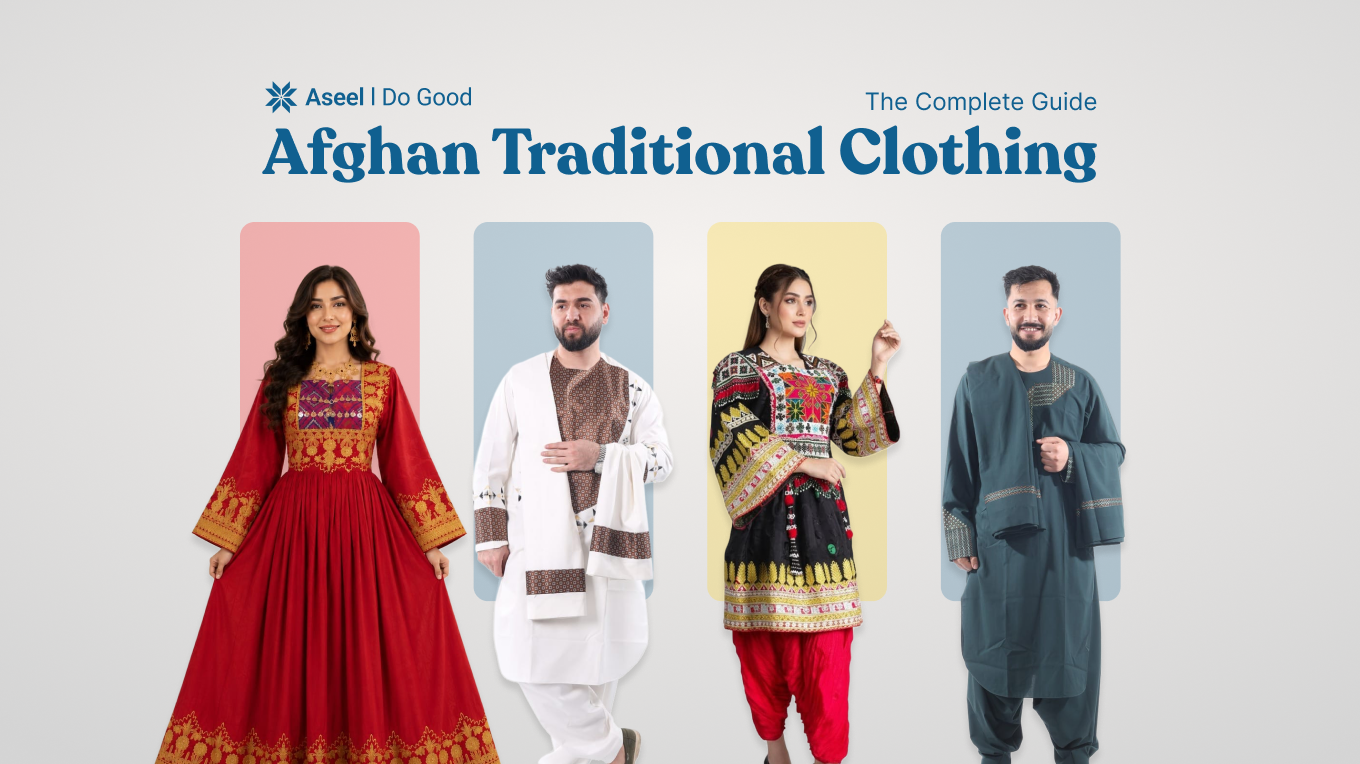
Afghan clothing is the family of garments traditionally worn in Afghanistan, and almost all of it is built from the same three pieces: a long loose shirt, wide trousers gathered at the waist with a drawstring, and some form of head covering. Men wear that combination as a peran tunban. Women wear the same structure in dress form, most often as a gand-e-afghani, a kuchi dress or a hazaragi dress, layered with a chador or a shoulder wrap. Coats such as the chapan and the sheepskin poostin, wool caps such as the pakol, and heavy wool shawls called patu complete the wardrobe. What separates one Afghan outfit from another is rarely the shape. It is the embroidery, the fabric, and the region the piece came from.
This guide covers every major garment by name, explains the embroidery techniques that give each piece its value, sets out the regional and ethnic differences that most guides skip, and shows how to judge authenticity before you buy. Where a claim comes from a published source, the source is named in the text so you can check it. Where the record is genuinely unclear, this guide says so instead of filling the gap.
What Is Afghan Clothing?
Afghan clothing is not a single national costume. It is a shared structure that dozens of communities decorate differently. The Textile Research Centre in Leiden, which maintains a digital exhibition on Afghan dress, describes the basic form as trousers gathered at the waist, called shalwar, worn with a loose-fitting shirt or dress called kamiz, finished with some form of head covering. That description holds for a farmer in Helmand, a bride in Kabul and a Hazara family in Bamyan. Everything else is variation.
The Encyclopaedia Iranica entry on clothing in Afghanistan records the same foundation in more technical language: loose-fitting, long-sleeved shirts worn outside wide trousers, with the trousers known variously as tanban, ezar or partog, gathered by a drawstring called an ezarband. Men's shirts, called peran or korta, are typically collarless and fasten at one shoulder rather than down the chest. That shoulder fastening is one of the quiet details that separates a genuine Afghan cut from a generic South Asian kurta.


The Three Garments Every Traditional Afghan Outfit Is Built From
The trousers come first. They are cut wide through the hip and thigh, taper at the ankle, and are held by a drawstring rather than a waistband, which is why so many Afghan garments are sold as free size and still fit properly. The shirt sits over the trousers rather than tucked into them, falls to the knee or below, and is cut loose enough to move and pray in. The head covering is the third element and the most socially legible one: a cap, a turban, a wool pakol, a scarf or a full wrap, depending on gender, region, generation and occasion.
Once you can see those three layers, the rest of the wardrobe reads as additions to them. A waistcoat goes over the shirt. A coat goes over the waistcoat. A shawl goes over everything. Nothing in the traditional Afghan wardrobe replaces the base outfit. It layers on top of it, which is also why the same pieces work across a forty degree temperature range.


Afghan Men Clothing Also Known As Perahan Tunban or Shalwar Kameez | Aseel
Why the Same Garment Has Five Different Spellings
Afghan garment names reach English through two languages, Dari and Pashto, and through no single agreed transliteration. The men's outfit appears as peran tunban, perahan tunban, perahan o tunban, piran tomban and pirahan tunban. The nomadic women's dress appears as kuchi and kochi. The formal Afghan dress appears as gand-e-afghani, gand afghani and gande afghani. The wool shawl appears as patu, patoo and pato. The wool cap appears as pakol, pakul and pakool.
None of these spellings is wrong. They are different romanisations of the same word, and the variation matters practically: search for one spelling and you will miss most of what is for sale under the others. Throughout this guide the most common English spelling is used first, with the main alternatives given once so that you can search either way.
Quick reference: the core Afghan garments
| Garment | Worn by | What it is | Typical use |
|---|---|---|---|
| Peran tunban | Men | Knee-length collarless shirt over wide drawstring trousers | Everyday and formal |
| Waskat | Men and women | Waistcoat worn over the shirt, often embroidered | Occasion layering |
| Gand-e-afghani | Women | Formal Afghan dress, often velvet, heavily embroidered | Weddings, Eid, Nowruz |
| Kuchi dress | Women | Nomadic dress with very full skirt, wide sleeves, coins and mirrors | Occasion and cultural events |
| Hazaragi dress | Women | Calf-length dress, full sleeves, wide at the waist | Occasion and cultural events |
| Chapan | Men and women | Long striped or ikat coat, often quilted | Winter and ceremonial |
| Poostin | Men and women | Sheepskin coat, fleece inward, embroidered outside | Winter |
| Pakol | Mostly men | Soft rolled wool cap with a flat round crown | Everyday, cold weather |
| Patu | Mostly men | Thick rectangular wool shawl | Wrap, blanket, prayer mat |
| Chador | Women | Rectangular head and shoulder cloth | Everyday and formal |
Afghan Men's Clothing
Afghan menswear is one outfit with many finishes. The same peran tunban a shopkeeper wears in unbleached cotton is worn to a wedding in fine cotton with hand embroidery down the collar band and cuffs. Reading men's Afghan clothing is mostly a matter of learning which additions signal which occasion.
Perahan Tunban, the Everyday Outfit
The perahan tunban is described as the standard traditional outfit for men, consisting of a tunic shirt, trousers and an optional head covering. The shirt is cut straight, with side slits from roughly hip level so the wearer can sit cross-legged, and it fastens at one shoulder or with a short placket. The trousers are voluminous at the top and narrow at the ankle.
Regional cutting and stitching traditions have their own names. The same entry records Kandahari doozi and Herati doozi as distinct styles, doozi meaning stitching. In practice the Kandahari version is associated with fine whitework embroidery on the collar band, placket and cuffs, while Herati work tends toward denser coloured thread. Fabric choice follows season rather than status: light cotton and cotton blends through the summer, heavier cotton and wool blends in winter, and velvet or fine cotton with visible hand embroidery for occasions.
The garment is often confused with the shalwar kameez sold across Pakistan and India, and it is closely related, but the Afghan cut is usually fuller through the body, longer in the shirt, and finished with the shoulder fastening described in Encyclopaedia Iranica rather than a front button placket.
The Waskat, the Embroidered Waistcoat
The waistcoat, called waskat, is the fastest way to move an Afghan outfit from everyday to formal. The Textile Research Centre lists the waskat as a standard component of Pashtun dress for both men and women, worn over the shirt. Occasion versions are made in velvet and covered in raised metallic or leather-appliqué embroidery, which is why a plain cotton peran tunban plus a heavily worked waskat is such a common wedding and Eid combination.


Afghan Men's Headwear: Pakol, Karakul, Skullcap and Turban
Headwear carries more information than any other Afghan garment. Encyclopaedia Iranica records that distinctive headgear marks ethnic identity across the country: Uzbek and Tajik cylindrical silk-embroidered caps, Hazara quilted chintz and felt caps, embroidered cylindrical golabatuni caps among the Pashtun of Kandahar, small mirror fragments called shisha set into Baluch designs, and busby-shaped sheepskin tilpak among the Turkmen. The same source notes that the turban can run from three to six metres in length, and is called langota or dastar in Persian and patkay or pagri in Pashto, usually wrapped over a cap called a kolah or kholay.
The pakol is the cap most people outside the region picture when they think of Afghanistan, and its history is more specific than most sellers admit. It is a soft, flat, rolled-up, round-topped wool cap originating in the Gilgit, Astore and Hunza areas of the extreme north of Pakistan, spreading to Chitral by the nineteenth century, and recorded in writing as early as 1880 when John Biddulph referred to a rolled woollen cap in Tribes of the Hindoo Koosh. It became strongly associated with Afghanistan during the conflict years, when it was known variously as the Tajik cap, Kolab cap and Panjshiri cap. It is made of wool in earthy colours including brown, black, grey and ivory, or dyed red with walnut, and the rolled brim can be pulled down over the ears in cold weather and rolled up when it is warm.


The karakul is the other well known Afghan hat, it is made of sheep fur in a typical Central Asian style and normally worn in conservative colours. It reads as formal and urban where the pakol reads as practical and rural.
The Chapan, Afghanistan's Best Known Coat
The chapan is a long coat, cut straight and generous, traditionally made of striped silk and worn for warmth in winter. Encyclopaedia Iranica groups it with the jilak among the quilted robes of northern Afghanistan, which is the key point about the garment: the chapan belongs to the wider Central Asian robe tradition that runs across northern Afghanistan, Uzbekistan and Tajikistan, and the ikat and adras silks it is made from come from that same shared textile world.
The coat became globally recognisable through Hamid Karzai, who wore a green chapan through his years as president. Artnet reported in April 2015 that Karzai donated one of his signature chapans, striped in purple and green, to the British Museum, where a spokeswoman called it an important addition to the collection and described it as a world-famous symbol of national and cultural identity. Karzai's own account, as reported there, is unglamorous: he started wearing it after arriving in Kabul following the fall of the Taliban because he needed something warm, having left his clothes in Pakistan.
The Poostin, the Sheepskin Coat the West Renamed
Encyclopaedia Iranica records the sheepskin coat as poostin when it has sleeves and poostincha when it does not. The Aseel entry on the Afghan coat describes the construction precisely: sheepskin or goatskin made up with the fleece on the inside and the soft suede-like leather on the outside, in lengths from jacket to ankle, often finely embroidered with silk thread. The same entry places the origin in Ghazni province, between Kabul and Kandahar, where Pashtun artisans made them for Afghan winters. In the West the same garment is simply called an Afghan coat, and its 1960s fame is covered later in this guide.
The Patu, a Shawl That Doubles as a Blanket
The patu is the most useful garment in the Afghan wardrobe and the least understood outside it. The Textile Research Centre describes it, in its account of Pashtun dress, as a large rectangular blanket, the thick version of the pair whose thin version is called a chador, and it lists three functions in one line: outerwear, something to sit on, and a prayer mat. That is exactly how it is used. A man wraps it over his shoulders walking to work, spreads it on the ground at midday, and prays on it in the afternoon.
It is woven from wool, it is heavy, and it is not a pashmina. Pashmina refers to fine cashmere goat fibre and produces a light, soft drape. A patu is a dense wool textile built for warmth and hard use. Both are shawls. They are not substitutes for each other, and the price difference in either direction usually reflects that rather than quality.


Afghan Winter Shawls and Hand Embroidered Shawls Also Know as Patu | Aseel
Afghan Men's Footwear
The Textile Research Centre lists pointed handmade slippers of the Persian and Indian type, boots worn particularly by Uzbeks in the north, wooden sandals for the bath house, and rubber sandals with soles cut from car tyres. The leather sandal worn with a peran tunban across southern Afghanistan, often sold as a Peshawari sandal, remains the standard warm-weather choice, and hand-knitted wool socks the standard cold-weather one.
Afghan Women's Clothing
Afghan womenswear follows the same trousers, dress and head covering structure, and the differences between the named dresses are differences of silhouette, colour convention and embroidery rather than of category. The Textile Research Centre sets out the Pashtun women's version as trousers called partug, a dress with long sleeves and a full skirt called kamiz, often a waskat, and some form of head covering, with festival garments made in silk or velvet in rich colours and especially deep red.
That source also records two decorative conventions worth knowing before you shop, because they are what hand-made occasion dresses are priced on. The first is beaded panels at the shoulders and along the seam line where the bodice meets the skirt. The second is embroidered roundels, called gul-i pirahan or gul-i peron in Dari, placed on the shoulders, the chest panel and the waist, worked with symbols associated with good luck, prosperity and fertility.
Gand-e-Afghani, the Formal Afghan Dress
Gand-e-afghani is the term most widely used for the formal Afghan women's dress, and it is the answer to the common question of what Afghan dresses are called. It is typically made in velvet or heavy silk, cut long, and worked across the bodice, sleeves and hem with metallic thread embroidery, mirrors, beadwork and applied trims. It is the dress worn to weddings, engagement parties, Eid gatherings and Nowruz, and it is the category Afghan families most often commission rather than buy ready-made, because the embroidery layout is chosen for the wearer.
Because it is a formal category rather than a single regional style, gand-e-afghani overlaps with the kuchi dress and the hazaragi dress in the market. The distinction that holds is one of origin: gand-e-afghani describes the formal Afghan dress broadly, while kuchi and hazaragi name dresses tied to specific communities and specific decorative vocabularies.
The Kuchi Dress
Kuchi dresses come from the Kuchi, the nomadic Pashtun communities of southern and southeastern Afghanistan. The Textile Research Centre describes nomadic women's clothing as following settled Pashtun styles but darker in colour, with long and very wide sleeves and very full skirts, decorated with couched metallic laces along with amulets, pendants, tassels and trinkets. That description explains almost everything distinctive about the garment: the extreme fullness of the skirt, the weight of the metalwork, and the sound the dress makes when the wearer moves.
The coins, beads and small mirrors on a kuchi dress are the feature buyers ask about most. On vintage pieces they are functional as well as decorative, since portable wealth and protective amulets both travel better sewn onto clothing than carried. On new pieces they are decorative, and the honest way to describe them is exactly that. Aseel's own guide to the garment sets out the embroidery techniques used on it in more detail, including charma dozi, which also appears as chermaduzi.
The Hazaragi Dress
Hazaragi dress belongs to the Hazara communities of central Afghanistan. The Textile Research Centre describes the women's outfit as trousers with a calf-length dress with long full sleeves, very wide at the waist, and notes that modern Hazara dresses usually have narrow sleeve cuffs and end at the knee or halfway down the calf. Festival versions, it records, tend to be purple velvet, though red is also worn. Waistcoats in this tradition are decorated with buttons, beads, silver coins and seashells.
The Hazara women's shirt is calf-length, close-collared and long-sleeved with slits on both sides, that younger women wear brighter fabrics while older women favour darker ones, and that the chador is often finished with beadwork and coin ornaments. It also names the fabric that matters most in this tradition: barak, described as a soft, durable, thick and moisture-resistant cloth made from the first wool of lambs, regarded as a stylish and regal cloth. Barak is the reason a Hazara men's coat can be both very warm and very light.
Chador, Chadari and Shal
The terms for Afghan women's head coverings are often used loosely in English, and the distinction is simple. Encyclopaedia Iranica describes the chador as a rectangular cloth, usually in fine cotton or a synthetic, worn over the head and shoulders. The chadari, known in English as the burqa, is a different garment entirely: a close-fitting cap from which finely pleated silk, cotton or rayon falls to envelop the whole figure. Shal refers to a shoulder wrap. A hijab, in Afghan usage as elsewhere, describes covering in general rather than one cut of cloth. Which of these a woman wears depends on region, family, generation and her own interpretation, and no single answer describes the country.
Afghan Embroidery Explained
Embroidery is where the value sits in Afghan clothing. Two dresses of the same cut and the same velvet can differ in price several times over on stitching alone, and the difference is legible once you know the techniques by name. Girls commonly begin learning embroidery early and that the skills are passed from mothers to daughters, which is why regional styles stay distinct across generations.
Khamak, Kandahar's Counted Whitework
Khamak is the most technically demanding embroidery in the Afghan repertoire. The Textile Research Centre describes it as Kandahari whitework, worked in satin stitch on a fine cotton or white silk ground, with the satin stitch traditionally worked from the reverse side of the material and great care taken so that the front and the back of the embroidery look alike. That last requirement is the whole test of the craft.
Kandahar Treasure, a Kandahar-based social enterprise built around the technique, describes the method from the maker's side: the design is never sketched first, because the pattern must be held in the mind, and the embroiderer counts thread by thread from a midpoint and works diagonally to build a framework of diamonds, stitching a small motif into the centre of each and filling the remaining spaces progressively. The organisation states that the technique is unique to Kandahar and traditionally decorated the floor-length shawls worn by southern Afghan men, and that it has provided work to more than a thousand women.
One note on sourcing, because it matters for accuracy. Both the Textile Research Centre and Kandahar Treasure place khamak in Kandahar and describe it as counted satin-stitch whitework. Khamak additionally associates the technique with Hazara women in the Hazarajat region. The Kandahar attribution is the better documented of the two, and this guide follows it.
Zardozi, Gold Thread Work
Zardozi is metallic thread embroidery. The Sources Related to Afghan clothing describes elaborate Afghan dresses as detailed with gold threading, called zardozi, along with gold beads, on silk fabrics in many colours for special occasions and weddings. It is raised, it catches light, and it is the technique responsible for the heavy bodice panels on formal gand-e-afghani dresses. Because metallic thread is stiff and heavy, zardozi work is concentrated where the garment does not need to drape: the bodice, the cuffs, the neckline and the hem band.
Charma Dozi, Coins and Mirror Work
Charma dozi, also written chermaduzi, is the appliqué-based technique associated with kuchi and southern Afghan dresses, and it is what produces the raised, tactile surfaces on kuchi bodices. Alongside it sit two applied decorations rather than stitches. Small mirrors, called shisha, are set into designs, a practice Encyclopaedia Iranica records specifically among the Baluch. Coins, beads and seashells are sewn on across kuchi and Hazara traditions, and the Textile Research Centre lists them explicitly on Hazara waistcoats. On antique pieces the coins are usually real currency. On new pieces they are usually decorative discs, and a seller who cannot tell you which is which is a seller to ask more questions of.
How to Tell Hand Embroidery From Machine Embroidery
The reverse side tells you almost everything. Hand embroidery has an irregular back, with visible thread paths, knots and small inconsistencies where the maker restarted. Machine embroidery has a uniform back, often with a bobbin thread in a different colour running in even lines, and frequently a stabiliser backing that has been trimmed rather than removed. On the front, hand-worked motifs vary very slightly in spacing and size across a repeat, while machine repeats are identical. Neither is a defect. Machine embroidery is faster, cheaper and perfectly serviceable. But it should be priced as machine embroidery, and the difference is easy to verify before you buy.
Hand versus machine embroidery, what to look for
| What you check | Hand worked | Machine worked |
|---|---|---|
| Reverse side | Irregular, visible knots and thread paths | Even, uniform, often a contrasting bobbin thread |
| Repeat motifs | Slight variation in size and spacing | Identical across every repeat |
| Backing | None, or a fabric lining only | Stabiliser residue trimmed at the edges |
| Thread ends | Secured by hand, sometimes visible | Cut flush, sometimes heat sealed |
| Density | Varies with the maker's hand | Consistent throughout |
Fabrics and Materials in Afghan Clothing
Encyclopaedia Iranica lists the common fabrics of Afghan dress as lightweight cotton, silk, velvet in red, green and royal purple, handwoven cotton called karbas, and wool. Each has a role that is worth understanding, because fabric is the second largest factor in price after embroidery.
Cotton, plain or handwoven as karbas, carries everyday clothing in both directions of the climate, since it is breathable in summer heat and layers well in winter. Velvet is the formal fabric of Afghan womenswear and of occasion waistcoats, chosen because it holds heavy metallic embroidery without puckering. Silk carries the northern coat tradition, particularly the striped and ikat-patterned adras silks used for chapans. Wool covers everything built for cold: the patu shawl, the pakol cap, and the barak cloth of the Hazara tradition made from the first wool of lambs. Sheepskin, worked fleece-inward, makes the poostin. Where a listing does not state the fibre, that omission is itself information, and it is a fair question to ask before ordering.
Regional and Ethnic Differences in Afghan Dress
Most guides to Afghan clothing stop at men's and women's wear. The regional layer is where the subject actually becomes useful, because it is what lets you identify a piece and understand what you are buying.
Pashtun Dress, Southern and Eastern Afghanistan
The Textile Research Centre sets out the Pashtun men's outfit as trousers called partug or shalwar with a drawstring called partugghakh, a knee-length shirt called kamiz, a waskat, a cap called khwalay or rakhchina usually wrapped with a turban called pagray, lungay or langota, and a large rectangular blanket, the thin chador or the thick patu. Kandahar within this region is the centre of khamak whitework. The Kuchi nomadic communities belong to this broader tradition, in darker colours and with far fuller skirts.
Tajik and Persian-Speaking Dress, Kabul, Herat and the Northeast
Encyclopaedia Iranica records cylindrical silk-embroidered caps among Uzbek and Tajik communities. Herat has its own recognised stitching tradition, referred to as Herati doozi alongside Kandahari doozi. Kabul, as the capital, is where Western dress entered earliest, and the same source notes that Western styles were introduced early in the twentieth century and remained prominent in the city through later decades, which is why urban Kabuli wardrobes have long mixed traditional and Western pieces.
Hazara Dress, Central Afghanistan
The Hazara tradition is the most distinct in silhouette, with the calf-length, wide-waisted women's dress described above, purple and red velvet for festivals, and coin, bead and seashell decoration on waistcoats. Encyclopaedia Iranica records quilted chintz and felt caps among the Hazara, and Hazara clothing names barak as the signature cloth and the turban of Khorasan among the headwear.
Uzbek and Turkmen Dress, Northern Afghanistan
The north is coat and robe country. Encyclopaedia Iranica records quilted robes called jilak and chapan in the northern regions, padded Uzbek coats called gopicha, boots worn particularly by Uzbeks, and busby-like sheepskin tilpak hats among the Turkmen. This is also where the ikat silk tradition that clothes the chapan comes from.
Nuristani Dress, the Eastern Mountains
Encyclopaedia Iranica singles out Nuristani dress as notably distinctive, with white woollen knee-length trousers worn with long black leggings called patow, and silver-studded belts unique to the region. Nuristan is also strongly associated with the pakol and with hand-rolled wool work more broadly.
Region and signature element
| Region or community | Signature element |
|---|---|
| Kandahar, Pashtun | Khamak counted whitework on shirts and shawls |
| Kuchi, southern nomadic | Very full skirts, wide sleeves, coins, mirrors, metallic lace |
| Herat | Herati doozi, denser coloured thread work |
| Hazarajat, Hazara | Calf-length wide-waisted dress, purple and red velvet, barak wool |
| Northern Afghanistan, Uzbek and Turkmen | Chapan and jilak robes, ikat silk, tilpak hats, boots |
| Nuristan and the northeast | Pakol wool caps, white wool trousers with patow leggings, silver-studded belts |
| Baluch communities | Shisha mirror fragments set into embroidery |
What Afghans Wear for Weddings, Eid and Nowruz
Three occasions drive most demand for Afghan clothing, and each one has its own conventions.
Weddings
Afghan weddings run across several distinct events rather than one, typically including an engagement gathering, a henna night and the wedding itself, and the dress expectation shifts at each. The Aseel entry on Afghan clothing notes that elaborate dresses detailed with zardozi gold threading and gold beads on silk are worn for special occasions and weddings. In practice the bride wears the heaviest embroidery of any event in Afghan life, often a green dress for the nikah portion in many families and a separate outfit for the reception, while guests wear formal gand-e-afghani, kuchi or hazaragi dresses depending on the community. Men pair a fine peran tunban with a heavily embroidered waskat, and in the north a chapan over both.
Eid
Eid is the occasion for new clothes rather than for the most elaborate ones. Families commonly buy or commission a fresh outfit for each of the two Eids, which for men usually means a new peran tunban in a lighter colour and for women a new formal dress. Because the demand spike is sharp and short, artisan lead times lengthen considerably in the weeks before both Eids, which is the single most useful piece of practical advice in this section: order early.
Nowruz
Nowruz, the Persian and Afghan new year on the spring equinox, is marked in Afghanistan and across the diaspora, and it is the occasion where regional dress is worn most deliberately as identity rather than as formality. Hazara families in particular use Nowruz gatherings and cultural days to wear hazaragi dress, and the same is true of Kuchi and other communities with their own styles. Colours skew brighter than at weddings because the festival marks spring.
Colours in Afghan Clothing, and What Can Honestly Be Said About Them
A great deal of what circulates online about colour symbolism in Afghan clothing is not traceable to any documented source, so it is worth separating what is recorded from what is repeated. Encyclopaedia Iranica records velvet in red, green and royal purple as common formal fabrics. The Textile Research Centre records that Pashtun festival garments favour silk or velvet in rich colours and especially deep red, that Hazara festival dresses tend toward purple velvet with red also worn, and that older Hazara women favour darker fabrics while younger women wear brighter ones. The Aseel entry on Hazara clothing repeats that generational pattern.
Those are the documented patterns: deep red for Pashtun festival wear, purple and red for Hazara festival wear, and an age gradient from bright to dark. Green appears frequently in Afghan bridal wear for the nikah, which is best treated as widely observed practice rather than a codified rule. Claims that assign a fixed meaning to every colour across all Afghan communities are not supported by the sources consulted here.
Afghan Clothing in Global Fashion
Two Afghan garments have crossed into global fashion, and both stories are documented well enough to state plainly.
The first is the poostin, the embroidered sheepskin coat, known in the West simply as the Afghan coat. The Wikipedia entry on the Afghan coat records that Craig Sams imported them to the United Kingdom in 1966 and sold them through hippie boutiques including Granny Takes a Trip on King's Road in London, that the Beatles visited, wore them publicly and generated substantial attention, and that the band wore them inside out on the Magical Mystery Tour album cover. It also records the consequence: demand outran the artisan makers of Ghazni, and mass-market imitations followed. John Lennon's coat was exhibited in 2009 and 2010 as part of the Julian Lennon Collection.
The second is the chapan, carried into global recognition by Hamid Karzai and now held in the British Museum's collection following his 2015 donation as reported by Artnet. The pakol travelled a similar route through photojournalism of the conflict years without being commercialised in the same way. What the cases share is that Afghan garments entered Western wardrobes as objects of interest first and as designs to copy second, and the copies rarely credited or paid the artisans they came from.
How to Buy Authentic Afghan Clothing
Authenticity in this category is not a single quality. It is three separate questions, and each has a verifiable answer.
Is the Technique What the Listing Says It Is?
This is the checkable one. Ask for a photograph of the reverse of the embroidery. Ask whether the embroidery is hand worked or machine worked, and ask specifically which technique, by name. A seller who works with artisans can answer that in a sentence. Ask what the fibre is, since velvet can be silk, cotton or polyester and wool can be blended, and ask where the piece was made. Vintage pieces should come with an approximate decade and an honest statement about wear and repair, and a vintage listing with no condition notes at all is worth a question.
Will It Fit?
Most traditional Afghan garments use drawstrings and generous cutting, which is why so much of the category is sold as free size and still fits a wide range of bodies. That tolerance has limits, and it is smaller for structured pieces than for loose ones. A bodice with heavy zardozi work does not give. A fitted waskat does not give. Sleeve length and total garment length are the two measurements that most often disappoint, so measure the shoulder to wrist and the shoulder to hem on a garment you already own and compare those numbers rather than relying on a size label. Where a maker offers custom measurement, which is common for occasion dresses and for peran tunban, it is usually the better route.
Where Does the Money Go?
The third question is the one this platform exists to answer. Aseel is an Afghan-founded marketplace, founded by Nasrat Khalid and headquartered in Arlington County, Virginia. NPR reported on the company's original ambition to become the Etsy of Afghanistan and on its later pivot toward humanitarian delivery. Aseel's Wikipedia entry records that between 2019 and 2023 the platform enabled 3,000 Afghan women to sell handicrafts online, and that in 2022 it distributed emergency aid packages across 24 of Afghanistan's 34 provinces. Every clothing purchase on the platform is made by a named artisan or artisan shop rather than by an anonymous supplier, and buyers can see whose work they are buying before they order.
That is a claim you can check rather than take on trust, which is the standard any seller in this category should be held to.
How to Care for Handmade Afghan Clothing
Handmade Afghan garments are durable, and most of the damage they suffer comes from being treated like machine-made clothing. Three rules cover almost everything. Metallic and mirror work should never go through a washing machine, because the agitation lifts couched thread and cracks mirror settings. Wool should be dried flat rather than hung, because wet wool stretches under its own weight. Velvet should never be pressed directly, because the pile crushes permanently and does not recover.
Beyond that, the material determines the method, and when a garment combines materials the most delicate one sets the rule for the whole piece.
Care by material
| Material | Cleaning | Storage |
|---|---|---|
| Velvet with metallic work | Professional dry clean only | Hang padded, never folded across the embroidery |
| Wool patu or pakol | Hand wash cool with wool detergent, no wringing | Fold flat, cedar or lavender against moths |
| Silk or ikat chapan | Professional dry clean only | Hang on a wide hanger, out of direct light |
| Cotton peran tunban | Cool machine wash inside out, low spin | Hang or fold, iron on the reverse |
| Coin, mirror or shell work | Spot clean only, never immersed | Flat, interleaved with tissue |
| Sheepskin poostin | Specialist leather and sheepskin cleaner | Hang loosely, never in plastic |
Frequently Asked Questions
What is traditional Afghan clothing called?
The men's outfit is called peran tunban, a knee-length collarless shirt worn over wide drawstring trousers. Women's dresses are called gand-e-afghani when formal, kuchi dress when they come from the southern nomadic tradition, and hazaragi dress when they come from the Hazara tradition. The underlying structure of trousers, a loose shirt or dress and a head covering is shared across all of them.
What is the difference between a peran tunban and a shalwar kameez?
They are closely related garments from the same regional clothing family. The Afghan cut is generally fuller through the body with a longer shirt, and Encyclopaedia Iranica records that Afghan men's shirts are typically collarless and fasten at one shoulder rather than down the front. Shalwar kameez, as worn across Pakistan and India, more commonly has a collar and a front placket.
What is the difference between a kuchi dress and a gand-e-afghani?
Gand-e-afghani is the broad term for the formal Afghan women's dress. Kuchi dress names a specific tradition, that of the nomadic Pashtun Kuchi communities of southern and southeastern Afghanistan, described by the Textile Research Centre as following settled Pashtun styles in darker colours with very wide sleeves, very full skirts and applied metallic lace, amulets, pendants and trinkets. A kuchi dress can be worn as formal Afghan dress. Not every formal Afghan dress is a kuchi dress.
Is the pakol an Afghan hat?
It is worn widely in Afghanistan and is strongly associated with the country, but its documented origin is the Hindu Kush region of what is now northern Pakistan. The Wikipedia entry traces it to the Gilgit, Astore and Hunza areas, spreading to Chitral by the nineteenth century, with a written reference to a rolled woollen cap as early as 1880. During Afghanistan's conflict years it became known as the Tajik cap, Kolab cap and Panjshiri cap.
What is khamak embroidery?
Khamak is counted satin-stitch whitework from Kandahar. The Textile Research Centre describes it as worked on fine cotton or white silk, stitched from the reverse side, with great care taken so that the front and back look alike. Kandahar Treasure describes the method as counting thread by thread from a midpoint and working diagonally to build a diamond framework, with no design sketched in advance.
Is a patu the same as a pashmina?
No. Pashmina refers to fine cashmere goat fibre and produces a light, soft shawl. A patu is a thick wool shawl, described by the Textile Research Centre in its account of Pashtun dress as a large rectangular blanket used as outerwear, as something to sit on and as a prayer mat. Both are shawls, but they are built for different purposes.
How do I know if Afghan clothing is handmade?
Look at the reverse of the embroidery. Hand work has an irregular back with visible knots and thread paths, and its repeated motifs vary slightly in size and spacing. Machine work has a uniform back, often with a contrasting bobbin thread and trimmed stabiliser, and identical repeats. Ask the seller to name the embroidery technique and the fibre, and ask for a photograph of the reverse before ordering.
Can non-Afghans wear Afghan clothing?
Yes, and Afghan garments have been worn internationally for decades, from the 1960s popularity of the embroidered sheepskin Afghan coat onward. What matters is buying from makers rather than from copies, describing pieces by their correct names, and not presenting ceremonial or bridal garments as costume. Buying a piece from the artisan who made it is the version of this that supports the tradition rather than extracting from it.
Where can I buy authentic handmade Afghan clothing?
Buy where the maker is named and the technique is stated. On Aseel, clothing is listed by the artisan or artisan shop that produced it, so the maker is visible before purchase. Aseel's Wikipedia entry records that the platform enabled 3,000 Afghan women to sell handicrafts online between 2019 and 2023.
Where to Go From Here
Afghan clothing is best understood one garment at a time, because the detail is where the interest is. The counted geometry of a khamak collar band, the exact fullness of a kuchi skirt, the difference between a chapan and a jilak in the north: none of that fits into a single guide, and each has its own dedicated guide on this site. If you are buying for a wedding, an Eid or a Nowruz gathering, start with the occasion guide for that event and work back to the garment. If you are buying for yourself and want to start with one piece, a wool patu or a pakol is the least demanding entry point, and a peran tunban or a gand-e-afghani is the most rewarding.
Whichever you choose, the questions are the same three: what is the technique, will it fit, and who gets paid. A seller who answers all three plainly is a seller worth buying from.

Afghan Clothing
Discover traditional Afghan clothing, crafted with heritage and timeless style.
ExploreAbout Aseel
Aseel is a tech-driven startup providing a digital marketplace where artisans can sell their one-of-a-kind handcrafted products while supporting humanitarian efforts worldwide. We champion using practical skills to create the positive impact businesses and communities deserve. Aseel's intuitive platform empowers thousands of makers by connecting them with a global audience. Transparency and privacy are at the heart of everything we do. Our dedicated customer service team is available anytime to assist clients through our secure and protected platform.
Follow Aseel on Google
Add Aseel as a preferred source on Google to see more of our stories in your Search results.