Afghan Leather Bags: Old Craft, Modern Style
Sep 03, 2026
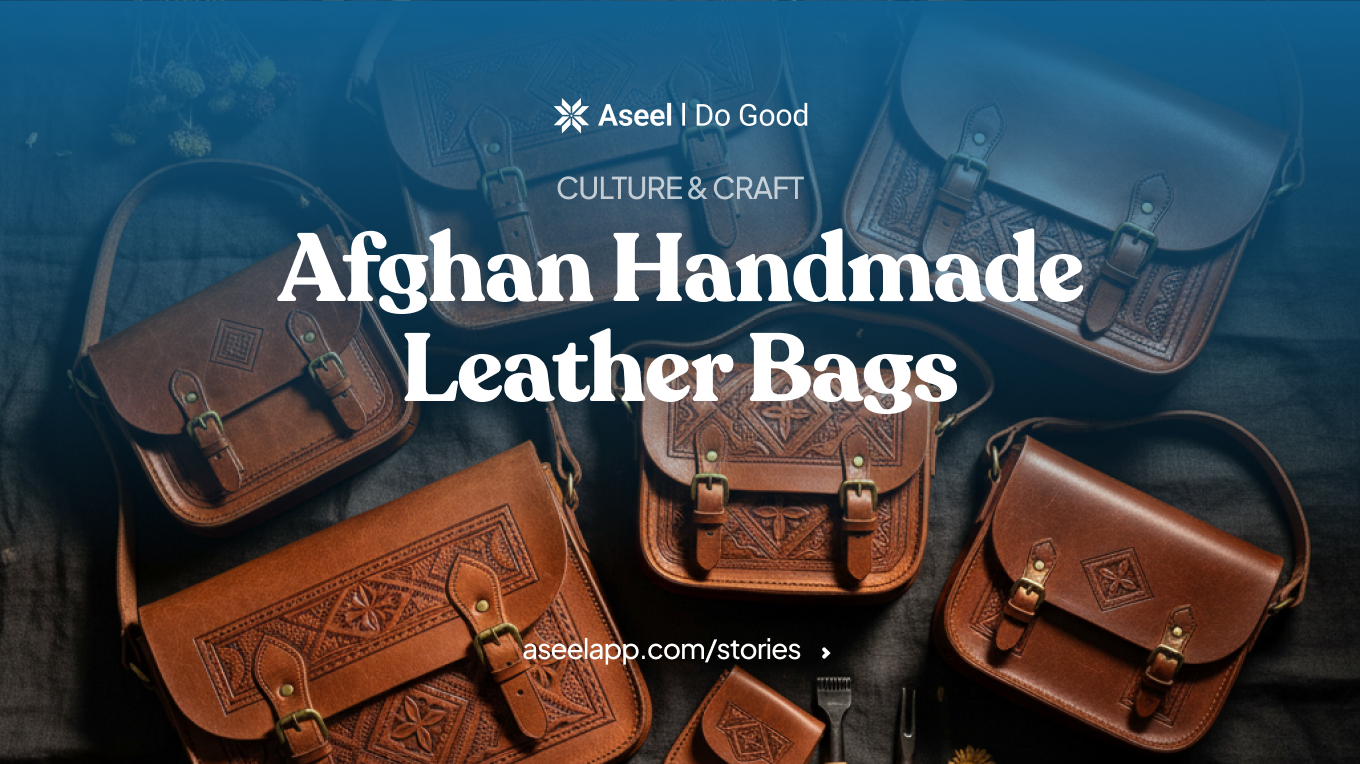
Afghan Handmade Leather Bags: Old Craft, Modern Style
An Afghan handmade leather bag is cut, stitched and finished by hand in Afghanistan, usually from goat or sheep hide, and often paired with a traditional woven cloth called gand afghani or with hand embroidery. Expect to pay somewhere between 60 and 190 US dollars, depending on size and whether it comes as part of a matching set.
The tricky part is not the price. It is that "Afghan leather bag" gets used online for at least four different products made in at least three different countries, and hardly anyone explains how to tell them apart.
So: what the leather actually is, what those four products are, three questions that settle provenance in about a minute, what things cost, and who makes them.
What Afghan leather bags are made from


Goat and Sheep, Not Cattle
Afghanistan's leather comes overwhelmingly from goats and sheep, and the herd numbers explain why. The UN Food and Agriculture Organization, launching a nationwide livestock survey in December 2024, recorded approximately 3.7 million cattle against approximately 16 million sheep and goats combined.
This shows directly in what Afghan workshops produce. Goat leather is the most common, and it is a genuinely good material for bags: durable, flexible, with a pronounced natural grain that takes on character with use. Sheep leather is thinner and softer. Cow leather is heavier and less common in Afghan bag-making.
FAO also records that livestock contributes about 15 percent, or roughly 680 million US dollars, to Afghanistan's agricultural GDP and supports over 1.1 million jobs. Note what that figure covers: livestock overall, not leather, and not leather bag-making. No verifiable employment figure exists for Afghanistan's leather sector specifically.


Gand Afghani, The fabric you will see alongside the leather
Many Afghan leather bags combine leather panels with gand afghani, a traditional Afghan woven fabric. Two of the workshops selling on Aseel list their bags' material as "Leather Goat's Skin and Gand Afghani," which is a more precise material declaration than most sellers anywhere provide.
If a bag combines leather with a striped or patterned woven panel, that panel is usually the gand, and it is part of what makes the bag identifiably Afghan rather than generically handmade.
Embroidery Traditions
Where bags carry embroidery, mirrors or coins, those traditions are far better documented than the leatherwork itself.
The Textile Research Centre in Leiden records khamak, the whitework embroidery of Kandahar, worked in satin stitch on fine cotton or white silk and traditionally stitched from the reverse side of the fabric. Herat has a comparable whitework style, with related forms among Nuristani communities east of Kabul.
The Centre also documents the wider material vocabulary: silk, cotton and wool yarns alongside metallic threads, spangles, sequins, mirrors and braids, and records that Pashtun and Baluchi women incorporate small mirrors (shisha), beads, coins and shells into nomadic dress. That is the documented basis for the mirrors and coins on tribal-style bags. Motifs are geometric and floral, including tulips and pomegranate blossoms, and stylised animal forms such as ram's horns and lions' tails.
Hand versus machine embroidery. Machine embroidery is now common and rarely disclosed. Hand embroidery shows slight irregularity in stitch length and spacing, and the reverse side looks different from the front. Machine work is uniform on both faces. Ask for a photograph of the reverse.
How leather is tanned in Afghanistan
The most detailed field description available comes from the trade publication Leather International, in a piece by Sam Setter published in July 2008. It is eighteen years old and should be read as a snapshot of that period rather than as current national data.
Setter described a large number of small artisanal tanneries operating as family businesses on small plots, with mud sheds and tanning pits dug into the ground, working without machinery. Tanning used locally available vegetable extracts and bird excrement, an approach he noted was by then extinct in Europe. Afghan tanners produced crust leather, which manufacturers then coloured and oiled for flexibility. He also recorded that the great majority of raw hides and skins were exported rather than tanned locally, going to Kazakhstan, Türkiye and Pakistan, and that shoe soles were made from old car tyres cut by hand.
There is a second, more recent account of a living process. Alive-in profiled Ghulam Haidar Akrami, known as Haji Mama, a Herat leathersmith aged 102 at the time of the March 2023 report, with 91 years in the trade. His process, using sheep and cow hides, ran: skinning, salting, washing, rolling, soaking in a salt and barley solution, drying, sun-baking, moisturising, shaving, cleaning, oiling and softening. He makes jackets, vests, hats, footwear, tablecloths, chair components and bags.
One important consideration. Sellers commonly describe Afghan leather as vegetable tanned. The 2008 account supports that for artisanal tanneries at that time, and some current sellers describe their leather as naturally tanned in northern Afghanistan. But no current national data on the vegetable versus chrome split in Afghanistan could be found. "Vegetable tanned" in a product description is a claim about that seller's supply chain, not a country-level fact. It is fair to ask a seller to substantiate it.
The four different products sold as "Afghan leather bags"
Most buyer confusion in this category comes from these being treated as one thing. They are not, and knowing which is which is most of the work.
1. New leather bags made in Afghanistan
Leather goods cut, stitched and finished by workshops inside Afghanistan, usually in Kabul, Herat, Bamyan or Mazar-i-Sharif. This is the category most buyers think they are shopping for, and it is what the workshops listed further down this page produce.
2. Bags assembled outside Afghanistan from Afghan textiles
A legitimate product that is frequently named in a misleading way. One example sold online is an "Afghani Leather Tote" built from vintage handmade textiles sourced from Afghanistan combined with camel leather and, by the seller's own product description, crafted by artisans in Jaipur, India. The textile is Afghan. The bag is Indian. Both facts are disclosed; the product name only tells you one of them.
3. Antique and vintage nomadic bags, which are woven rather than leather
This is the category with the deepest documented history, and it is textile. The nomadic bag tradition across Afghanistan and Central Asia produced the khorjin (a double bag slung over a donkey or horse), the cuval or camel bag, the mafrash or bedding bag, and the taache or grain bag, made as hand-knotted pile or as kilim and soumak flatweave. These reach genuinely high prices; one dealer lists a pre-twentieth-century Afghan tribal bag in 100 percent wool at over 550 US dollars.
Bags in this tradition are woven wool. "Leather Kuchi bag" is a modern commercial construct, not a documented nomadic tradition.
4. Karakul goods, which are pelt rather than tanned leather
Karakul is the fleece pelt of the karakul lamb. It is a separate material with a separate trade and a real ethical question attached, and it is frequently listed online as "karakul leather." Treating it as interchangeable with tanned hide is a factual error. More on this below.
When a listing says "Afghan handmade leather bag," find out which of these four it is. Sellers with real supply chains will tell you.


How to check provenance: the three-question test
This is the most useful thing on this page, and no seller currently offers it. There are three separate questions here, and the answers can be three different countries.
1. Where was the leather tanned? Afghan tanneries produce crust leather from goat, sheep and cow hides. But even legitimate Afghan makers use imported inputs: one Kabul-based seller states openly that its sheep leather is imported from Pakistan. "Made in Afghanistan" does not automatically mean "materials from Afghanistan," and a seller saying so plainly is a good sign rather than a bad one.
2. Where was the bag assembled? This is the question a product name usually answers, and sometimes answers wrongly. The Jaipur-made "Afghani" tote is the clearest example.
3. Where was the decoration made? Embroidered panels, kilim inserts and vintage textile pieces are sometimes sourced separately from wherever the bag was stitched.
A seller who can answer all three is telling you the truth. A seller who cannot answer any of them may still be selling a good bag, but you are buying on faith.
Other checks worth making
-> Is it actually leather? Faux leather is sold in this category at prices overlapping genuine leather, so price tells you nothing about material. Ask directly, and look for the standard indicators: genuine leather has an irregular pore pattern, a distinctive smell, and cut edges that look fibrous rather than uniform.
-> Which hide? Goat, sheep and cow are meaningfully different products at meaningfully different weights.
-> Shade variation is a good sign. One Kabul-supplied seller makes this point well: their leather is not static in colour, and that variation indicates natural tanning rather than a heavy pigment coating. Naturally tanned leather also darkens and softens with age.
-> Ask where the money goes. One seller publishes that about 30 percent of the purchase price returns to the producers in Kabul. Whether that number is typical matters less than the fact that they publish it. Ask anyone.
What Afghan leather bags cost
These are prices observed on live retail pages, not estimates.
| Category | Observed range |
|---|---|
| Afghan-made leather bags and purses | roughly 59 to 190 US dollars or euros |
| Afghan-made matching sets (bag, purse and shoes) | roughly 125 to 190 US dollars |
| Embroidered textile handbags | roughly 50 to 130 US dollars |
| Faux leather handbags sold in the same category | 120 to 130 US dollars |
| Antique and vintage nomadic woven bags | roughly 125 to 550 US dollars |
| Karakul bags and backpacks | roughly 100 to 150 US dollars |
Two things follow. The ranges overlap heavily, so price is not a guide to authenticity or to material. And the most expensive category, antique nomadic bags, is not leather at all.
Karakul: the part sellers do not explain
Karakul goods sit alongside leather bags in most listings, often described as "karakul leather," and they carry a question buyers deserve to have put plainly.
Karakul is the pelt of the karakul lamb. The industry's decline, reported by Arab News in 2021, is well documented: roughly 10 million pieces exported to the West at the 1970s peak, around 500,000 skins by 2017, and 17,000 pieces exported to Uzbekistan in 2020. Balkh province, historically a centre of the trade, once had 280 shops selling karakul skins; by 2021 only three or four remained. Karakul caps have sold for as much as 3,000 dollars.
The report attributes the collapse to growing opposition to the practice of removing pelts from newborn lambs. As the head of the provincial agriculture department put it: "In the past 10 years, the industry has gone bankrupt. There is no market for it now."
If a listing says "karakul leather," it is describing a pelt. Whether you want to buy it is your call. You should be making that call knowingly.
What "Kuchi" means, and what it does not
The term is used loosely in this category, and the accurate version comes from peer-reviewed anthropology rather than retail copy.
Richard Tapper's paper "Who are the Kuchi? Nomad self-identities in Afghanistan", published in the Journal of the Royal Anthropological Institute in 2008, establishes four things.
"Kuchi" derives from the Afghan Persian kuch, meaning migration. It means, roughly, those who go on migrations, and it is a generic label for Afghanistan's pastoral nomads.
It is not an ethnic group or a tribe. Most people so labelled self-identify as Pashtuns, from the Durrani and Ghilji confederations, but nomadic pastoralists also exist among Aimaq, Baluch, Arab, Kirghiz, Turkmen and Uzbek communities.
It was historically an exonym, and often derogatory. In the 1960s and 1970s, nomads generally identified themselves as maldar, meaning herd-owner.
Population figures circulating online are inflated. Tapper argues that commonly repeated estimates, including six million and an official figure of over 16 percent of the population, are exaggerated by a factor of at least two, with around 10 percent more plausible.
Minority Rights Group records that Kuchi communities traditionally owned around 30 percent of Afghanistan's sheep and goats plus most of its camels, that the droughts of 1971 to 1972 and 1998 to 2002 reportedly killed 75 percent of their livestock, and that only a few thousand still follow the migratory livelihood.
So "Kuchi bag" is a broad label for a nomadic decorative style, not an identification of tribal origin. And the genuine nomadic bag tradition it gestures at is woven, not leather.
Who actually makes Afghan leather bags on Aseel
This is the part of the three-question test you can check for yourself. Every workshop below has a named founder, a stated city and a stated year, and every link goes to that workshop's own page.
Wakhjir Handicrafts, Kabul
Founded by Khalilullah Hamdard, on Aseel since 2022. The workshop makes handmade leather bags, shoes and accessories incorporating traditional gand fabric, and states that it was established to highlight authentic Afghan craftsmanship and offer an alternative to cheap imports. It emphasises responsible material sourcing and minimising waste.
Their full handcrafted leather set, at the upper end of the range, comes in silver, lapis lazuli blue, green, jaggery and yellow.
See Wakhjir Handicrafts.
Lora Bright, Kabul
Founded by Marziah Hafizi, a journalism graduate who launched the line in 2018 and joined Aseel in 2022. Her stated purpose is directly relevant to everything above: she started the business to help Afghan producers take back market share and reduce reliance on imports from Turkey, India and Iran. That is the provenance problem described in this guide, addressed from the production side.
Lora Bright's listings are unusually specific about material, giving it as "Leather Goat's Skin and Gand Afghani" on every piece. The range covers single bags and matching sets:
-> Leather envelope clutch bag, cream
-> Leather clutch and envelope hand purse
-> Leather envelope hand purse
-> Leather pouch-style shoulder bag with zip, striped with a leather strap
-> Cross-body shoulder bag, clutch and shoes
-> Complete matching set: shoulder bag, purse and shoes
See Lora Bright.
Ibticar Jawanan Handicrafts, Bamyan
Founded by Mina Ebrahimi in late 2021, on Aseel since 2025, operating from Shop No. 17 in the Bamyan Art Market. The workshop involves over 60 artisans, predominantly women, many from low-income backgrounds or unable to continue formal education. In Ebrahimi's own words, she started the business "with a simple but strong purpose: to grow our traditional handicrafts and create real job opportunities for women and girls."
Bamyan is worth noting on its own. Most Afghan leather production discussed anywhere is Kabul, Herat or Mazar-i-Sharif, so a Bamyan workshop is a genuinely less-documented origin.
See Ibticar Jawanan Handicrafts.
La Michelle, Kabul
Launched in 2021 and on Aseel since 2026, La Michelle positions itself around blending modern design with traditional detail rather than around traditional forms alone. It is the newest of the workshops here.
See La Michelle.
The Handmade Boutique, Kabul
Founded by Mohsin Kakar, on Aseel since 2023, working with both women and men artisans across Afghanistan and shipping to customers in the United States, Canada and Australia.
One disclosure, because this guide is about provenance
Not every leather brand on a marketplace selling Afghan goods is Afghan, and it would be inconsistent to write this guide without saying so. Lummbo, founded by Özlem Barın and inspired by her grandfather's handmade leather shoe atelier, is based in Istanbul, Turkey, and works in traditional saddlery techniques. It is genuine handmade leather. It is not Afghan leather.
That distinction is exactly what the three-question test is for, and it applies to every marketplace including this one. Check the workshop's stated city before you assume.
Browse handmade leather goods on Aseel. Every product page names the workshop that made it.
Questions to ask any seller before you buy
These work on any seller in this category, not only on Aseel.
1- Which country was the leather tanned in?
2- Which city or workshop assembled the bag?
3- Is the leather goat, sheep, cow or something else?
4- Is it vegetable tanned, chrome tanned, or do you not know?
5- Is the embroidery hand-stitched or machine-stitched?
6- If it is described as karakul, is it a pelt?
7- What proportion of the price reaches the maker?
A seller who answers all seven straightforwardly, including saying "I do not know" where they do not, is worth buying from. Precision, not marketing language, is the signal.
Caring for Afghan leather
Naturally tanned leather behaves differently from heavily finished commercial leather, and most sellers in this category publish no care guidance at all.
-> Expect the colour to deepen with use. That is the leather ageing, not a defect.
-> Keep it out of prolonged direct sun, which dries and cracks untreated leather.
-> Condition occasionally with a neutral leather balm. Avoid heavy waxes on thin goat or sheep leather.
-> Blot water rather than rubbing it, and let a wet bag dry away from direct heat.
-> Store stuffed lightly rather than flat, so the shape holds.
-> Where a bag combines leather with a woven gand panel or hand embroidery, spot-clean the fabric rather than immersing the whole bag.
Frequently asked questions
What are Afghan handmade leather bags made from?
Most often goat leather, with sheep also common and cow less so. This follows the country's herd composition: FAO recorded approximately 16 million sheep and goats against approximately 3.7 million cattle. Many Afghan bags combine leather with gand afghani, a traditional Afghan woven fabric, or with hand embroidery.
How can you tell if an Afghan leather bag is really made in Afghanistan?
Ask three separate questions: where the leather was tanned, where the bag was assembled, and where any decoration was made. These can be three different countries. Product names in this category sometimes reflect only the textile's origin. Sellers with genuine supply chains can name the workshop and the city.
What should an Afghan handmade leather bag cost?
Observed retail prices for Afghan-made leather bags and purses run from roughly 59 to 190 US dollars, with matching bag, purse and shoe sets at the upper end. Note that faux leather bags in the same category are listed at 120 to 130 dollars, so price alone tells you nothing about the material.
Is Afghan leather vegetable tanned?
Some of it is. A 2008 trade-press field survey documented artisanal tanneries using vegetable extracts and pit tanning, and some current sellers describe their leather as naturally tanned in northern Afghanistan. But no current national data on the vegetable versus chrome split could be found, so treat "vegetable tanned" as a claim about a specific seller's supply chain rather than a general fact.
What is gand afghani?
A traditional Afghan woven fabric used alongside leather in many Afghan-made bags. Several Kabul workshops list their bags' material as "leather goat's skin and gand afghani." A striped or patterned woven panel set into a leather bag is usually the gand.
What is a Kuchi bag?
"Kuchi" comes from the Afghan Persian kuch, meaning migration, and is a broad label for Afghanistan's pastoral nomads rather than a specific ethnic group or tribe. Commercially, "Kuchi bag" describes a nomadic decorative style. The documented nomadic bag tradition, including the khorjin, is woven wool rather than leather.
Is karakul the same as leather?
No. Karakul is the fleece pelt of the karakul lamb, not tanned hide. It is often listed as "karakul leather." The trade has collapsed since its 1970s peak, from roughly 10 million pieces exported annually to 17,000 pieces exported to Uzbekistan in 2020, attributed to opposition to taking pelts from newborn lambs.
What is a khorjin?
A decorative bag from the nomadic and village weaving traditions of Greater Iran and Central Asia, made as hand-knotted pile or as kilim and soumak flatweave. Related forms include the cuval or camel bag, the mafrash or bedding bag, and the taache or grain bag.
Are Afghan leather bags a traditional craft?
Afghan leatherworking is documented, including tanning practices and a named 102-year-old Herat leathersmith with 91 years in the trade. But no source establishes Afghan leather bag-making as a documented historical craft tradition in the way that carpets, embroidery, karakul and the postin coat are documented. The case for these bags rests on materials, workmanship and provenance rather than on heritage claims.
The short version
Afghan leather is mostly goat and sheep. Good Afghan bags often pair it with gand afghani or hand embroidery. The category mixes four genuinely different products, and price will not tell you which one you are looking at.
Three questions will: where was the leather tanned, where was the bag made, where was the decoration made. Anyone who can answer all three is worth your money.
Media Inquiries
For media inquiries, press requests, or interview opportunities related to this article or Aseel, please contact:
About Aseel
Aseel is a tech-driven startup providing a digital marketplace where artisans can sell their one-of-a-kind handcrafted products while supporting humanitarian efforts worldwide. We champion using practical skills to create the positive impact businesses and communities deserve. Aseel's intuitive platform empowers thousands of makers by connecting them with a global audience. Transparency and privacy are at the heart of everything we do. Our dedicated customer service team is available anytime to assist clients through our secure and protected platform.
Follow Aseel on Google
Add Aseel as a preferred source on Google to see more of our stories in your Search results.