August 2021 to August 2026: Five Years of Do Good

Sep 03, 2026
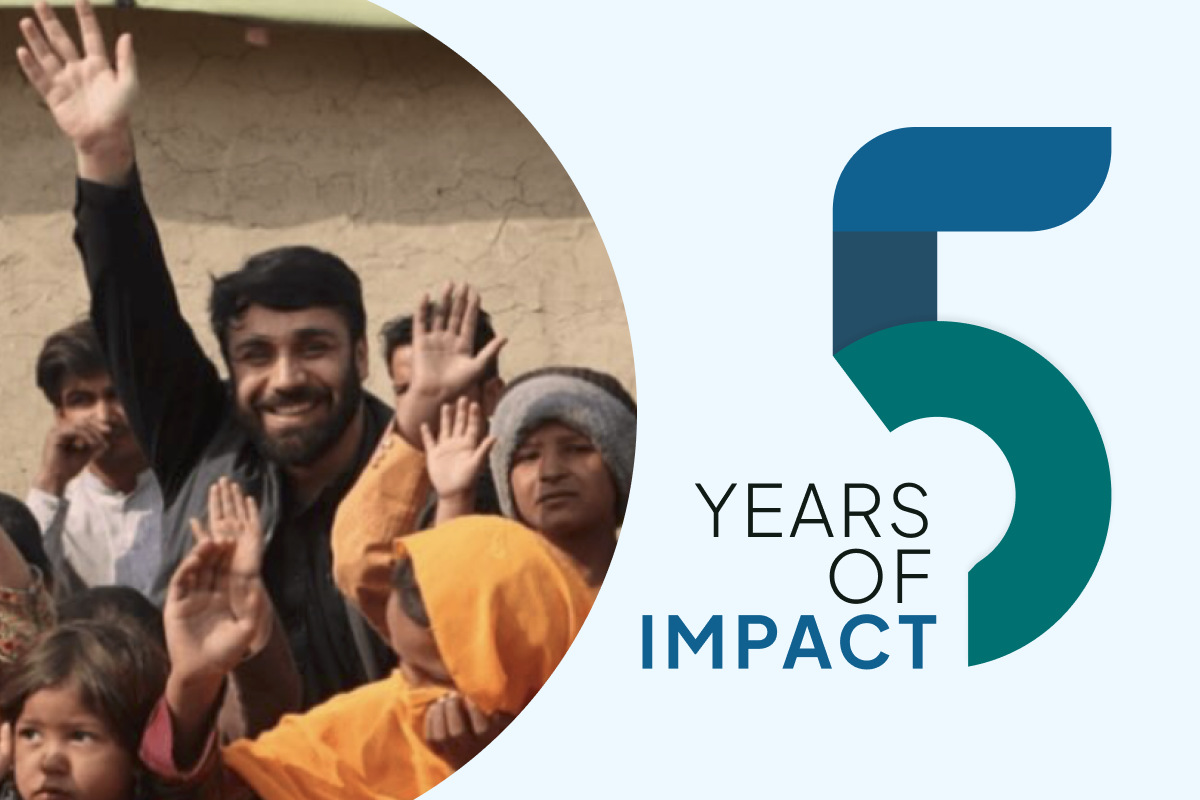
Aseel Do Good at 5: From $42,000 to 839,300 People
Five years ago this month, a small Afghan e-commerce startup emptied its bank account and started buying rice.
That is not a figure of speech. In August 2021, as Kabul fell and the international aid system froze up, Aseel founder Nasrat Khalid told his team in Afghanistan to take the roughly $42,000 the company held in profit and spend it on emergency food packages for displaced families. Al Jazeera reported the decision at the time. Other business people warned him it would kill the company. It did the opposite.
Aseel's live impact counter now reads 839,300 individuals and 119,900 families supported, with more than $5 million delivered to communities. For comparison, Technical.ly reported 642,500 people in November 2025, which means roughly 200,000 more people have been reached in the nine months since.
Here is the five year story, including the parts that usually get left out.

What Aseel Actually Is (And What Most People Get Wrong)
The most common mistake people make about Aseel is thinking it only works in Afghanistan, Gaza and Sudan. It does not.
Aseel is a global crowdfunding platform. Anyone, anywhere in the world, can open Campaign+ and raise money for a cause. That cause does not have to be a war or a famine. It can be a hospital bill, a school building, a scholarship fund, or a community project.

Don’t Let Her Dream Die
In Kabul, girls still dream of learning, even when the world around them tells them to stop dreaming.
For many families, buying a school uniform, notebooks and basic supplies is a struggle. We want to help these girls stay in school and hold on to the small hope they still have.
A schoolbag may be simple, but behind it is a girl with a dream, a future and a life she deserves to choose.
Help us keep her dream alive.
What makes Aseel different sits underneath the fundraising. Where other platforms stop when the payment clears, Aseel keeps going until someone hands over a package and photographs it. In Afghanistan, Gaza and Sudan, where the company runs its own ground teams, that means the delivery is done end to end. Everywhere else, the crowdfunding tools are open to anyone.
The two halves of the platform
| Side | What it does | Who it is for |
|---|---|---|
| Campaign+ | Global crowdfunding. Raise money for health, education, emergencies, humanitarian work or institutional causes | Anyone, anywhere. Individuals, nonprofits, schools, community groups |
| Direct Aid | Buy a specific physical package for a verified family, with photo confirmation of handover | Donors supporting Afghanistan, Gaza and Sudan, where Aseel runs ground teams |
There is a third piece, Buy Good, which is the original artisan marketplace and still runs. And a fourth, AidOS, which is the software layer Aseel now rents out to other organisations.


Snapshots of Aseel Best Features
What people actually raise money for
Aseel's own guidance lists five campaign categories: emergency relief, humanitarian causes, health, education and institutional. The best evidence that the platform works beyond crisis response is its own flagship campaign, the Afghan Women Tech Leadership programme, which funds remote high skill work for Afghan women. It has raised $279,350 toward a $370,000 goal, roughly 75 percent funded. That is not emergency relief. That is long term development, funded through the same crowdfunding tools available to any user.


Aseel Doing Good in Gaza
The Three Parts That Make Delivery Work
| Part | What it is | What it fixes |
|---|---|---|
| Omid ID | A verified recipient profile, created before any aid is sent. Omid means hope | Stops duplicate claims and links a specific donation to a specific person |
| Atalan Network | Local couriers and surveyors, paid per job. Atalan means heroes in Pashto | Removes the need for armoured convoys, foreign staff and security escorts |
| AidOS | The software behind all of it, opened to outside organisations in August 2025 | Lets other nonprofits run the same verified last mile without building it themselves |
Khalid described the Atalan system to Al Jazeera as working like a gig app. One person surveys a household, a second person checks the first person's findings, and only then does anything get delivered. By July 2022 that network already covered 180 volunteers across 25 provinces, each paid with a phone card and about $3 per delivery.
August 2021: The Decision That Made Everything Else Possible
Aseel was never meant to be an aid organisation. Khalid, a former World Bank technologist who grew up in Pakistani refugee camps and returned to Kabul in 2009, built the marketplace as an Etsy of Afghanistan. It went live at the Afghan Embassy in Washington, D.C. in May 2019 with 11 vendors and did about $35,000 in sales in its first year, Khalid told NPR.
Then the government collapsed, $7 billion in Afghan reserves were frozen, and the banks stopped working.
Why a craft marketplace turned out to be the right tool
This is the part most coverage skips, and it is the real reason the switch worked. Aseel had already spent two years building three things that emergency responders usually do not have on day one.
| Built for selling rugs | How it became aid infrastructure |
|---|---|
| Relationships with 400+ vendors and wholesalers | Instant local buying, no imports, no customs delays |
| A rural network of artisans across the provinces | The starting point for the Atalan courier and survey network |
| Card payment rails serving buyers in the US and Australia | A donation channel that never touched the frozen Afghan banking system |
The company added an Emergency Support category to its existing app in early August 2021. No new organisation, no new registration, no new supply chain. TIME visited in October 2021, when the total was just over 1,400 families. Eleven months later it was 212,000 people. Today it is 839,300.
Because the money came from individual card donations and not institutional grants, the aid cuts that shut down other operators simply did not apply. That independence is the most overlooked fact of the first five years.
Aseel vs GoFundMe vs LaunchGood: An Honest Comparison
Aseel now competes directly with the big crowdfunding platforms, so the comparison is fair to make. It should still be made accurately.
Aseel has not raised more money than GoFundMe or LaunchGood. GoFundMe has moved over $40 billion since 2010. LaunchGood has raised over $688 million across 155 countries. Aseel's lifetime total is above $5 million. Anyone telling you otherwise is selling something.
What Aseel does is finish a job the other two are not built to finish. GoFundMe and LaunchGood are fundraising rails. They end at a bank account. Aseel is a fundraising platform attached to a delivery company.
Where the money stops on each platform
| GoFundMe | LaunchGood | Aseel | |
|---|---|---|---|
| Who can start a campaign | Anyone in a supported country | Mostly registered organisations | Anyone, anywhere |
| Cause types | Any personal or charitable cause | Charitable and faith aligned causes | Emergency, humanitarian, health, education, institutional |
| Money ends at | A bank account in a supported country | An organisation's bank account | A photographed handover, in countries where Aseel has teams |
| Recipient identity check | No | Organisation level | Yes, Omid ID at the individual level |
| Proof for each donation | No | Campaign updates | Photo, video or message |
| Total raised to date | Over $40 billion | Over $688 million | Over $5 million |
The payout problem, explained
GoFundMe's own help centre says funds can only be sent to a short list of supported countries, that the person withdrawing needs a bank account in that country, and that if you are raising for someone in an unsupported country the organiser personally becomes responsible for getting the money the rest of the way. As a US company it also has to follow OFAC sanctions rules. Afghanistan, Gaza and Sudan are not on the payout list.
LaunchGood handles part of this by working through vetted organisations rather than individuals. Its campaign requirements are built around registered entities with audited accounts. That is a real safeguard and it works. It also means an unregistered family in Khost or Khan Younis is not the unit being funded.
Khalid has described Do Good to Technical.ly as working like a more transparent GoFundMe. That is a better description than competitor, because the two things do different jobs. One raises money. The other raises money and then delivers.
Worth being clear about: verified last mile delivery is slower and costs more per dollar than wiring a grant. It does not scale the way a UN pipeline scales. Aseel's critics have said so in public, and that is covered below.
Five Years, Four Countries: The Timeline
| Period | What happened |
|---|---|
| 2017 to 2019 | Aseel founded by Nasrat Khalid. Marketplace launches May 2019 at the Afghan Embassy in Washington, D.C. with 11 vendors |
| August 2021 | Kabul falls. Emergency Support added to the app. Roughly $42,000 of company profit turned into food packages |
| October 2021 | TIME reports aid reaching more than 1,400 families across several provinces |
| June 2022 | Paktika and Khost earthquake. Aseel teams reach Gaiyan district the next morning, ahead of most international responders |
| July 2022 | 212,000 people reached. Atalan network at 180 volunteers across 25 provinces |
| February 2023 | Response extended to survivors of the Türkiye and Syria earthquakes |
| 2023 | Campaign+ opens fundraising to any user for health, education and institutional causes, not only emergencies |
| 2023 to 2024 | Andrew Rice Award for Excellence in Development, Extreme Tech Challenge Japan, MIT Solve semi finalist. $850,000 pre seed raised in 2024 |
| August 2025 | AidOS launched publicly. 25 nonprofits and NGOs onboarded to pilot, including the International Finance Corporation |
| Late 2025 into 2026 | Gaza and Sudan operations scale through Aseel Foundation, a US 501(c)(3). Platform v2.5 ships |
| August 2026 | Five years of Do Good. 839,300 individuals and 119,900 families supported, over $5 million delivered |


Aseel Rapid Responses to Every Natural and Human Made Disasters
Where the Ground Teams Work, and Why Those Three Countries
Campaign+ is open worldwide. Direct Aid with photo proof is a different thing, because it needs people on the ground. Aseel runs those teams in three places, and they were not picked for marketing reasons. They are the three biggest gaps between what is needed and what is being delivered.
| Country | Scale of need | Funding reality |
|---|---|---|
| Afghanistan | 21.9 million people need humanitarian assistance in 2026, about 45 percent of the population. 17.4 million face acute food insecurity | The $1.71 billion UN response plan was roughly 26 percent funded as of August 2026 |
| Sudan | 33.7 million people in need, the highest number in the world. Nearly 19.5 million face crisis level hunger in the latest IPC analysis | WFP reports 825,000 children expected to face severe acute malnutrition in 2026 |
| Gaza and the West Bank | 3.6 million people targeted under the 2026 Flash Appeal, which asks for just over $4 billion | Access restrictions and bureaucratic delays are the main limit, not only money |
Afghanistan, where it started
Do Good now reaches every corner of 34 provinces of Afghanistan . The work has never been only food. It has included winter kits, first aid, infant formula, tents and cash. The artisan side kept running too, which matters more than it sounds. Between 2019 and 2023 roughly 3,000 Afghan women sold products through the platform, at a point when almost every other way for women to earn was closing.
Gaza, the hardest delivery problem
The Gaza operation runs the same way: verified recipient, physical package or cash, photo at handover. Packages are priced openly instead of pooled into a general fund. Published pricing has included an emergency basic food package at around $23.20 plus a flat delivery fee, which is unusual in a sector that rarely publishes unit costs at all.

Being straight about this: no independent operator controls access to Gaza. When crossings close, nothing moves, whatever platform you used. Proof of delivery means you find out what happened to your donation. It does not remove the blockage.
Sudan, the least funded emergency in the world
Sudan is the largest humanitarian caseload on earth and, by percentage funded, among the most ignored. It is also where local delivery has the clearest advantage, because mutual aid networks are already doing most of the real work. Aseel Foundation's Sudan programme is the newest of the three and the least written about by outside media so far. Treat its results as early rather than proven.
What the Money Buys
One useful thing Aseel does for donor trust is publish prices instead of adjectives.
| Package type | Indicative cost | Note |
|---|---|---|
| Basic emergency food package (Afghanistan, 2022 pricing) | Around $85 | Lentils, rice, beans, flour, oil, biscuits, sugar, green tea |
| Emergency basic food package (Gaza, 2026 pricing) | Around $23.20 | Plus a flat delivery fee for the Atalan handover |
| Hygiene and care kit (Gaza, 2026 pricing) | Around $29.00 | Contents listed at the point of donation |
Prices move with local markets and currency, so check the Direct Aid page for current figures before quoting them anywhere. The point is not the exact number. The point is that a number exists at all.
The Fair Criticisms, Because a Five Year Retrospective Without Them Is Just Marketing
Aseel has been challenged in public, and the challenges are worth repeating.
Scale. Afghan academic Safiullah Taye told Al Jazeera in 2022 that an app should not be treated as a replacement for a government's duty to its people, and questioned whether a platform good at small parcels could carry a national emergency. That point stands. Aseel has supported 839,300 people over five years. OCHA is trying to reach 17.5 million in Afghanistan in 2026 alone.
Oversight. Taye also raised accountability directly: more donation apps means more choice, but possibly less monitoring and protection than an institution with formal checks. Aseel's answer is the audit trail itself, the Omid ID and the delivery photo. Whether a per transaction audit trail replaces institutional safeguarding is still an open argument, not a settled one.
Money. Khalid told Technical.ly he met roughly 300 venture capitalists and raised $850,000, mostly from people he already knew. A company reaching this many people on that little funding is either an efficiency story or an underinvestment story. It is probably both.
Saying this out loud is not hedging. Someone deciding where to send money in 2026 is better served by an accurate picture than a flattering one.
What the Next Five Years Look Like
Two things have changed the direction recently.
The first is AidOS, which turns Aseel from an aid operator into infrastructure other operators use. Twenty five nonprofits and NGOs were piloting it as of late 2025. If that works, Aseel's own impact number stops being the right way to measure Aseel.
The second is reach. Khalid has said he intends to extend the model to all 44 countries the UN classifies as least developed within five years. That is a bigger ask than adding another crisis, because it means the marketplace and the crowdfunding side have to work too. Emergency aid keeps people alive. Income is what makes the aid unnecessary.
Five years ago the bet was that a rug marketplace could feed people faster than the international system could. In the narrow case, that bet was right. The next five years test whether it works everywhere else.
You can start a campaign for any cause on Campaign+, send a package through Direct Aid, browse people currently seeking support, or read the full media archive.
Frequently Asked Questions
What is Aseel Do Good?
Aseel Do Good is the giving side of Aseel, a global platform founded by Nasrat Khalid. Anyone anywhere can raise money for a cause through Campaign+, and donors supporting Afghanistan, Gaza or Sudan can buy a specific aid package that a local courier delivers and photographs. It launched in August 2021.
Can I use Aseel to fundraise outside Afghanistan, Gaza and Sudan?
Yes. Campaign+ is open to anyone in the world for any cause, including health, education, emergency relief, humanitarian work and institutional projects. The three country focus applies to Direct Aid, where Aseel runs its own delivery teams on the ground.
How did Aseel Do Good start?
It started in August 2021, when Afghanistan's government collapsed and the banking system froze. Aseel added an emergency category to its existing shopping app and turned roughly $42,000 of company profit into food packages, using vendor relationships built for its artisan marketplace.
Is Aseel better than GoFundMe or LaunchGood?
They do different jobs. GoFundMe has raised over $40 billion and LaunchGood over $688 million, both far more than Aseel. But both are fundraising platforms that pay out to a bank account. Aseel raises money and then delivers physical aid with proof, in places those payout rails do not reach.
Why can't GoFundMe send money to Afghanistan, Gaza or Sudan?
GoFundMe can only transfer funds to a short list of supported countries, and the person withdrawing needs a bank account there. As a US company it also follows OFAC sanctions rules. Its help centre says raising for someone in an unsupported country makes the organiser personally responsible for delivering the funds.
What is an Omid ID card?
Omid means hope. It is a verified recipient profile created before any aid is sent, which prevents duplicate claims and creates a record linking a specific donation to a specific person.
Who are the Atalan?
Atalan means heroes in Pashto. They are the local couriers and surveyors who assess households, confirm need and hand over packages. They are paid per job rather than salaried, which keeps delivery cheap in places international agencies reach expensively or not at all.
Is Aseel a registered charity, and are donations tax deductible?
Aseel operates as a technology company headquartered in Arlington, Virginia. The Aseel Foundation is a US 501(c)(3), and donations through it are described as tax deductible and Zakat eligible. Confirm current status directly before filing.
How many people has Aseel helped?
839,300 individuals and 119,900 families, with more than $5 million delivered, according to Aseel's live impact counter in August 2026. Technical.ly reported 642,500 people in November 2025. Aseel's stated goal, Mission 1 Million, is to reach one million people with proof of delivery.
Has Aseel been covered by credible media?
Yes. TIME, NPR, Al Jazeera, BBC, Reuters, Devex and The New Humanitarian have all reported on the platform. Devex covered the switch to aid in December 2022. Recognition includes the 2023 Andrew Rice Award for Excellence in Development and MIT Solve semi finalist status.

Media Inquiries
For media inquiries, press requests, or interview opportunities related to this article or Aseel, please contact:
About Aseel
Aseel is a tech-driven startup providing a digital marketplace where artisans can sell their one-of-a-kind handcrafted products while supporting humanitarian efforts worldwide. We champion using practical skills to create the positive impact businesses and communities deserve. Aseel's intuitive platform empowers thousands of makers by connecting them with a global audience. Transparency and privacy are at the heart of everything we do. Our dedicated customer service team is available anytime to assist clients through our secure and protected platform.
Follow Aseel on Google
Add Aseel as a preferred source on Google to see more of our stories in your Search results.