Which Gand-e-Afghani Should You Order
Sep 03, 2026
Buying a Gand-e-Afghani: How to Choose an Afghan Dress
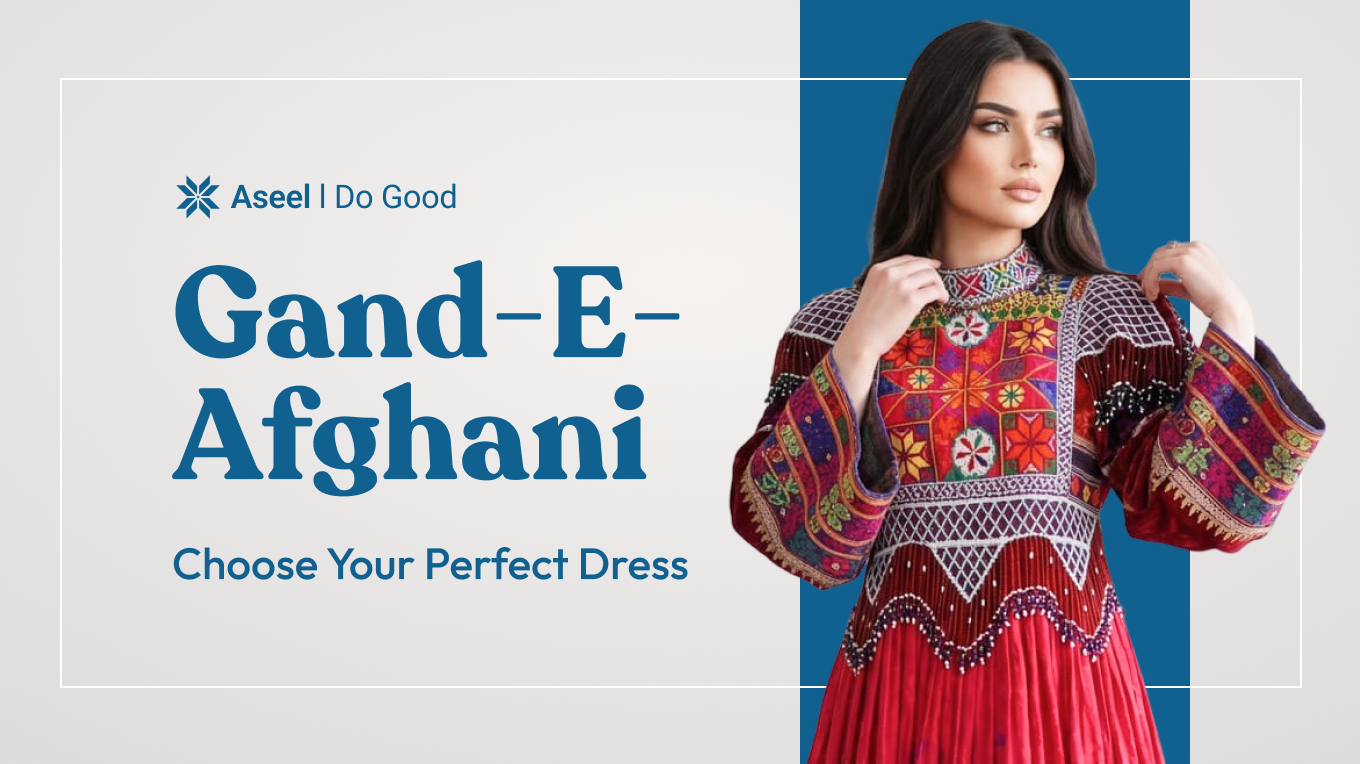
A gand-e-afghani is the formal Afghan women's dress: cut long and full, usually in velvet or heavy silk, worked across the bodice, sleeves and hem with metallic thread, mirrors and beadwork. It is what Afghan women wear to weddings, engagement parties, Eid gatherings and Nowruz, and it is the dress most Afghan families commission rather than buy off a rail, because the embroidery is laid out for the woman who will wear it.
If you are choosing one, five things move the price and four things decide whether it fits. This post covers all nine, plus how to pick colour by occasion, what to wear with it, and the questions worth asking before you pay. The full Afghan wardrobe, including men's dress, coats and headwear, is covered in the main guide to Afghan clothing.
What a Gand-e-Afghani Actually Is
The name is the everyday Afghan term for the formal dress, and you will see it written gand-e-afghani, gand afghani and gande afghani. All three refer to the same category. It is the answer to the question of what Afghan dresses are called, and it is the term Afghan families themselves use when they are talking about an occasion dress rather than a specific regional style.


The Silhouette
The dress runs long, usually to the ankle, over a matching or contrasting pair of trousers cut wide through the leg and gathered at the ankle. The bodice is fitted enough to hold the embroidery flat, the skirt is full enough to move in, and the sleeves are long. A wide belt or sash at the waist is common on newer designs and optional on traditional ones.
The embroidery sits where the fabric does not need to drape: a panel across the chest, bands down the sleeves and cuffs, a border at the hem, and often roundels at the shoulders. That placement is not decorative accident. Metallic thread is stiff and heavy, and a skirt embroidered all over would hang like a curtain instead of falling properly. When you see a dress with dense work across the full skirt, look closely at whether the weight is real thread or printed trim.
Gand-e-Afghani, Kuchi or Hazaragi
These three names get used interchangeably by sellers and they are not the same dress. Gand-e-afghani is the broad formal category. Kuchi and hazaragi name dresses tied to specific communities with their own decorative vocabularies.
| Dress | Silhouette | Signature work | Typical colours |
|---|---|---|---|
| Gand-e-afghani | Long, full skirt | Zardozi, beadwork | Any, velvet common |
| Kuchi | Very full skirt | Coins, mirrors, lace | Deep, darker tones |
| Hazaragi | Calf length | Charmaduzi stitch | Purple, maroon, red |
The practical use of that table: if a listing says gand-e-afghani but the photograph shows coins and small mirrors sewn across a very full skirt, you are looking at a kuchi dress. Both are excellent. Buy the one you actually want.


Different Afghan Dresses Afghan Kuchi Dress and Hazargi Dress
The Five Things That Set the Price
Two dresses in the same velvet and the same cut can differ several times over in price. Here is where the money goes.
Hand Embroidery or Machine Embroidery
This is the largest single factor, and it is the easiest to verify. Ask for a photograph of the reverse of the bodice.
Hand work has an irregular back, with visible knots, thread paths and small inconsistencies where the embroiderer restarted. Motifs across a repeat vary slightly in size and spacing. Machine work has a uniform back, usually with a bobbin thread in a contrasting colour running in even lines, and a stabiliser backing trimmed at the edges rather than removed, and every repeat is identical.
Machine embroidery is not a fault. It is faster, far cheaper, and perfectly good for a dress you will wear a handful of times. It should be priced as machine embroidery. On Aseel, the maker is named on every listing and the technique is stated, so this is a question you can answer before you add to basket rather than after it arrives.
The Embroidery Technique
Three techniques account for most of what you will see, and they cost differently.
Zardozi is metallic thread work, raised and light-catching, and it is what makes a formal bodice look formal. It is worked in gold or silver thread over a firm ground, which is why it appears on velvet and heavy silk rather than on chiffon.
Charma dozi, also written chermaduzi, is appliqué-based and produces the raised, tactile surfaces most people associate with Afghan and Kuchi bodices. It is the technique that gives a dress texture you can feel with a hand rather than just see in a photograph.
Mirror and bead work is applied rather than stitched, small mirrors and beads set into a design. On antique dresses the discs are sometimes real coins. On new dresses they are decorative, and any honest seller will say so.
| Technique | What it looks like | Where it sits | Cost |
|---|---|---|---|
| Zardozi | Raised metallic gold | Bodice, cuffs, hem | Highest |
| Charma dozi | Textured appliqué | Bodice, sleeves | High |
| Mirror work | Small set mirrors | Bodice, shoulders | Medium |
| Machine trim | Flat, even repeats | Anywhere | Lowest |
The Fabric
Velvet is the traditional formal choice, and it is chosen for a technical reason: it holds heavy metallic embroidery without puckering. Silk carries a lighter, more fluid version of the same dress. Banarasi and brocade are used where the fabric itself carries the pattern and the embroidery is lighter. Chiffon appears on modern and fusion designs, and it will not carry heavy zardozi, so a chiffon dress with a dense bodice usually has a separate lined panel underneath.
Ask what the velvet is. Velvet can be silk, cotton or polyester, and all three photograph the same. The difference shows in weight, in how it drapes and in how it survives storage.

Free Size or Made to Measure
Most gand-e-afghani dresses are sold as free size, and that works better than it sounds because the skirt is full and the trousers use a drawstring. It stops working at the bodice. A chest panel covered in zardozi does not stretch at all, so free size on a heavily embroidered dress means the bodice fits a range and the skirt fits everyone.
Made to measure costs more and it is usually worth it, particularly for a wedding. Aseel's artisan partners take custom orders on most occasion dresses, and the embroidery layout is then set for your proportions rather than for a standard block.
New or Vintage
Vintage dresses carry real age, sometimes real coins, and often repairs. They are one of a kind and they cannot be replaced if damaged. A vintage listing should state an approximate decade and be honest about wear, thinning velvet and replaced trims. A vintage listing with no condition notes at all is worth a question before you commit.
Choosing by Occasion
Afghan occasion dress follows conventions, and matching the dress to the event is most of getting it right.
| Occasion | What to wear | Embroidery weight |
|---|---|---|
| Bride, nikah | Green, heavy work | Heaviest |
| Bride, reception | Red or maroon velvet | Very heavy |
| Henna night | Bright, lighter dress | Medium |
| Engagement | Velvet, jewel tones | Heavy |
| Wedding guest | Velvet or silk | Medium to heavy |
| Eid | New dress, any colour | Medium |
| Nowruz | Bright spring tones | Light to medium |
The one rule that matters as a guest: do not out-embroider the bride. She wears the heaviest work in the room, and that is the point.
Colour, and What Afghan Families Actually Wear
A lot of what circulates online about Afghan colour symbolism cannot be traced to anything, so here is what holds in practice among the families Aseel's artisans make for.
Deep red and maroon are the traditional festival colours across most Afghan communities, and velvet in those tones is the default for a formal dress. Purple and maroon velvet are particularly associated with Hazara occasion dress. Green carries religious association and appears very often on brides for the nikah portion of a wedding. Royal blue, emerald and gold have become common on newer designs. Older women generally choose darker fabrics and younger women brighter ones, which is a real and consistent pattern rather than a rule anyone enforces.
Beyond that, claims that assign a fixed meaning to every colour across all of Afghanistan are not something Aseel will repeat, because the artisans themselves do not agree on them.
Getting the Fit Right
Four measurements decide whether a gand-e-afghani fits, and only one of them is forgiving.
Bust is the tight one, because the embroidered bodice does not give. Measure at the fullest point over the underwear you will actually wear. Shoulder to hem decides length, and a gand-e-afghani should reach the ankle rather than the floor, since a hem that drags will fray the embroidery within a season. Sleeve length runs from the shoulder seam to the wrist bone, and Afghan formal sleeves are long by design, so do not order short. Waist is the forgiving one on a full-skirted dress, and on the trousers it is a drawstring.
If you are between sizes on the bust, order up and have the bodice taken in locally. Taking in is straightforward. Letting out an embroidered panel is not possible.
What to Wear With It
The dress is one piece of a complete look, and the additions are where an outfit stops looking like a costume and starts looking right.
Jewellery first, because "gand afghani jewellery" is one of the most searched pairings and it is the fastest upgrade. Traditional Afghan pieces run to silver with lapis lazuli, coin necklaces, chokers, bangles and layered head ornaments. Heavy jewellery works with a lighter dress, and a heavily embroidered bodice needs less at the neck. You can browse the range at Aseel Afghan Jewlery Sets.
Then the head and shoulder covering. A chador is a rectangular cloth worn over the head and shoulders, usually in fine cotton or a light synthetic, and a shal is a shoulder wrap. Both are chosen to sit with the dress rather than to match it exactly. Many formal dresses are sold with a matching scarf, and if yours is not, a plain chador in a tone from the embroidery works better than a contrast.
Footwear is usually a flat or low embroidered shoe. A very long dress and a high heel is a combination that ends with a torn hem.
Ordering for a Wedding, Eid or Nowruz
Lead time is the thing people get wrong, and it is the one thing no amount of money fixes at the last minute.
Hand-embroidered dresses take weeks, not days, and the queue lengthens sharply before both Eids and before Nowruz, because every family in the country is ordering at once. If your date is fixed, order six to eight weeks ahead for a custom hand-embroidered dress, and four weeks ahead for a ready-made one that needs alteration. For a bride, start three months out, because a bridal dress usually means two outfits and at least one fitting.
Ask for a stated lead time in writing before you pay a deposit. Any artisan who works to order will give you one.
Girls' and Mother-Daughter Dresses
Gand-e-afghani for kids is a real and popular category, and matching mother and daughter dresses are a standard order at weddings and Eid. Two practical notes. Children grow, so a girl's dress ordered three months ahead of an event should be measured with a little room in the bodice and hem rather than fitted exactly. And heavy zardozi is uncomfortable for a small child to wear for a long evening, so lighter charma dozi or mirror work is usually the better choice at that size.


Collection of Afghan Clothes for girls Kuchi Dress, Hazargi Dress and Casual Wears
What to Ask Before You Pay
Four questions separate a good purchase from a guess. Is the embroidery hand worked or machine worked, and can I see a photograph of the reverse? What is the fabric, and if it is velvet, what fibre? Is this free size or made to measure, and what is the bust measurement on the size you are recommending? And what is the lead time in writing?
A seller who works directly with the makers answers all four quickly. A reseller who buys in bulk will manage two. On Aseel, every dress is listed under the artisan or artisan shop that made it, so you know whose work you are buying before you order, and custom measurement is available on most occasion pieces.
Washing and Storing It
The most delicate element on the dress sets the rule for the whole dress. On a gand-e-afghani, that is almost always the embroidery.
Velvet with metallic work goes to a dry cleaner, and only to one you have told about the embroidery. Never put it in a machine, because agitation lifts couched metallic thread off the surface and cracks mirror settings. Never press velvet directly, because the pile crushes and does not come back. Steam it from the reverse at a distance instead.
For storage, hang the dress on a padded hanger rather than folding it across the embroidered panels, which is where creases become permanent. Keep it out of direct light, since metallic thread tarnishes and velvet fades. If you must fold it, interleave tissue through the embroidery. For a dress you will wear once a year, a breathable cotton garment bag is worth the small cost, and plastic is not, because it traps moisture against the velvet.
Frequently Asked Questions
What is a gand-e-afghani dress?
It is the formal Afghan women's dress: long and full, usually velvet or heavy silk, embroidered across the bodice, sleeves and hem, worn with matching wide trousers. It is the dress worn to Afghan weddings, engagements, Eid and Nowruz.
What is the difference between a gand-e-afghani and a kuchi dress?
Gand-e-afghani is the broad formal category. A kuchi dress belongs to the nomadic Kuchi tradition of southern Afghanistan, with a very full skirt, wide sleeves and applied coins, mirrors and metallic lace. A kuchi dress can be worn as formal Afghan dress. Not every formal Afghan dress is a kuchi dress.
How much does a gand-e-afghani cost?
Price tracks five things: hand or machine embroidery, which technique, the fabric and its fibre, whether it is made to measure, and whether it is new or vintage. A machine-embroidered polyester velvet dress sits at the bottom of the range and a hand-worked zardozi silk velvet dress made to measure at the top. Check current listings rather than any figure quoted in an article.
Is a gand-e-afghani free size?
Most are, and it works for the skirt and the drawstring trousers. It does not work for the bust, because an embroidered bodice has no stretch. If you are between sizes, order up and have it taken in.
What colour should an Afghan wedding guest wear?
Velvet in a jewel tone is the safe and traditional choice, in medium to heavy embroidery. Leave the heaviest work and the bridal colours to the bride.
Can I get a gand-e-afghani made to my measurements?
Yes. Custom measurement is standard for Afghan occasion dresses and available on most pieces on Aseel. Allow six to eight weeks for hand embroidery, longer before Eid and Nowruz.
Are there gand-e-afghani dresses for girls?
Yes, and matching mother and daughter sets are a common order for weddings and Eid. Choose lighter embroidery for a child, since heavy metallic work is uncomfortable over a long evening.
How do I wash a velvet Afghan dress?
Dry clean only, and tell the cleaner about the embroidery. Never machine wash and never press the velvet directly. Steam from the reverse and store on a padded hanger.
Ready to Order
If you know your bust measurement and your shoulder-to-hem length, and you have decided between hand and machine embroidery, you are ready.
Start with the Gand Afghani Dress Collection.
Discover timeless Afghan Women styles for every wardrobe.
Complete your look with traditional Afghan jewelry sets.
If you want the coins-and-mirrors look instead, read our guide to buying an Afghan kuchi dress. For Hazara occasion dress, see choosing a hazaragi dress. If you are dressing for a specific event, start with what to wear to an Afghan wedding. For Eid, see buying an Afghan dress for Eid. And for the full wardrobe, read the main guide to Afghan clothing.

Media Inquiries
For media inquiries, press requests, or interview opportunities related to this article or Aseel, please contact:
About Aseel
Aseel is a tech-driven startup providing a digital marketplace where artisans can sell their one-of-a-kind handcrafted products while supporting humanitarian efforts worldwide. We champion using practical skills to create the positive impact businesses and communities deserve. Aseel's intuitive platform empowers thousands of makers by connecting them with a global audience. Transparency and privacy are at the heart of everything we do. Our dedicated customer service team is available anytime to assist clients through our secure and protected platform.
Follow Aseel on Google
Add Aseel as a preferred source on Google to see more of our stories in your Search results.