Istalif Pottery: Afghanistan's Turquoise Ware
Sep 03, 2026
Istalif Pottery: The Turquoise Ceramics of Afghanistan
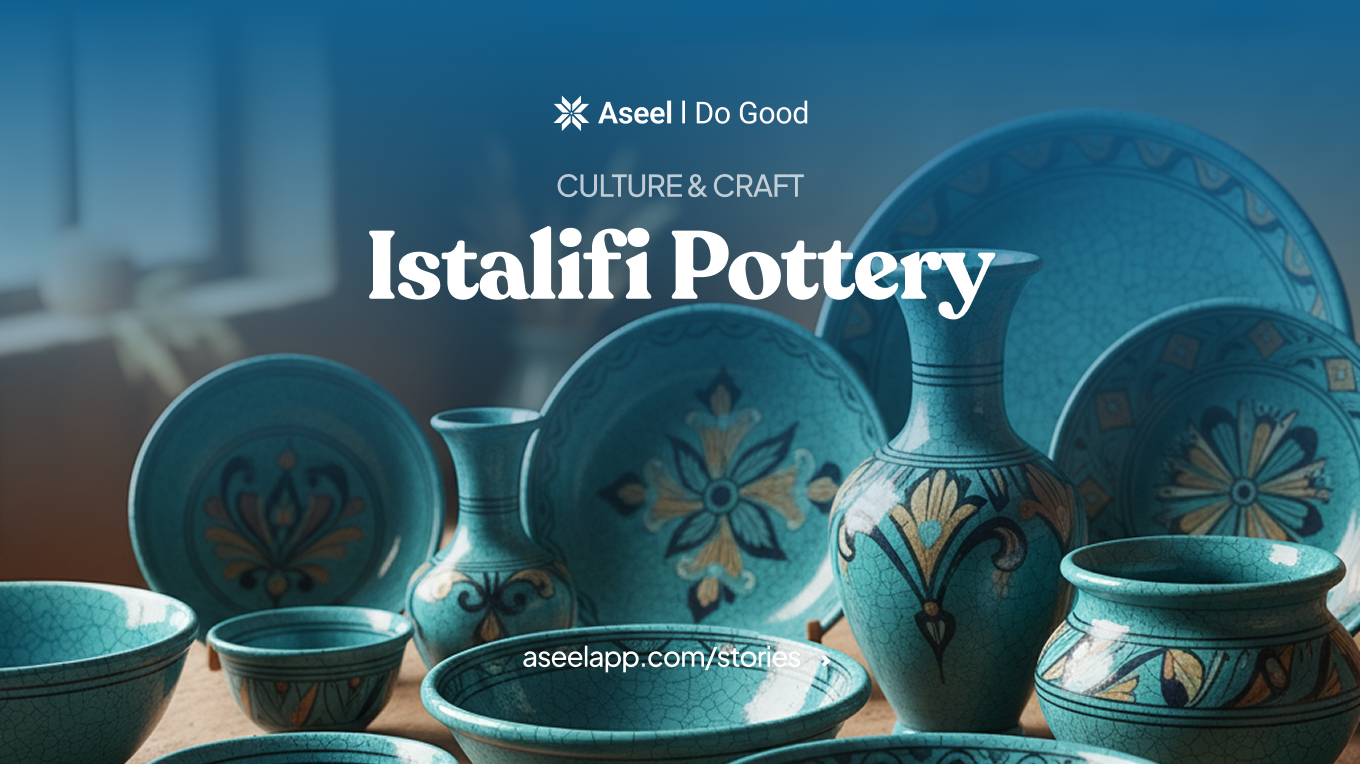
There is a particular blue-green that people remember from Afghanistan. It appears on bowls, plates, jugs and teapots, always slightly different from piece to piece, usually with dark geometric lines scratched through the glaze. It comes from Istalif, a village north of Kabul, and it has been made by the same families for generations.
Most of what is written about Istalif pottery in English is either very short or repeats claims that cannot be traced anywhere. This article uses the two best sources on the subject, which almost no other page has read, and is explicit about what is documented and what is not.
What is Istalif pottery?
Istalif pottery is glazed earthenware made in the village of Istalif in Kabul Province, Afghanistan, known for a distinctive turquoise glaze and for hand-incised geometric decoration. It is thrown on a foot-powered wheel, glazed by hand, and fired in wood-burning kilns.
The craft is concentrated in one part of the village. AFP has reported that the potters' quarter is called Qarya-e-Kulalan, meaning "the potters' village."
You will see the ware called Istalif pottery, Istalifi pottery, Istalifi ware and occasionally Estalef pottery, which is the academic transliteration used by Encyclopaedia Iranica. They all refer to the same thing.


Kitchen Decor Istallefi Pottery | Aseel
Where is Istalif?
Istalif sits in the Kohdaman area on the southern edge of the Hindu Kush, overlooking the Shomali Plain, north of Kabul. Encyclopaedia Iranica places it at an altitude of 1,875 to 1,950 metres.
The distance from Kabul is reported inconsistently, so here is the honest range. Encyclopaedia Iranica gives 55 kilometres north. Yale University's Department of the History of Art gives roughly 35 miles, which is about 56 kilometres. AFP gives around 50 kilometres north-west. UNHCR gives 40 kilometres north. Every source that mentions travel time puts it at roughly one hour to ninety minutes by road.
A fair summary: roughly 40 to 55 kilometres north of Kabul, about an hour's drive. Any page giving you a single precise figure is choosing one source and not telling you the others exist.
The name's origin is also unresolved. Encyclopaedia Iranica offers two possibilities without choosing between them: the Greek staphilè, meaning a bunch of grapes, which would imply Hellenistic contact, or the Parāčī word estuf, meaning cow-parsnip.
How old is the craft?
You will find claims that Istalif pottery is over a thousand years old, and one page that says 1,400 years while also attributing the craft's arrival to Alexander the Great, who lived roughly 2,300 years ago. Those claims are internally inconsistent and unsupported.
Here is what can actually be established.
The village itself is first documented in the early 16th century, according to Encyclopaedia Iranica. Babur held gatherings there and admired the place. In the 19th century the explorer Charles Masson described it as one of the most picturesque spots he had seen.
On the pottery specifically, Encyclopaedia Iranica gives no origin date at all, describing pottery as one of Istalif's two handicraft traditions "of old fame." That silence from the most rigorous source available is itself informative.
The potters' own account, recorded by Turquoise Mountain, traces the craft back roughly 400 years to a figure named Sayyid Mir Kolal, who fled political upheaval, reached Balkh, and settled in Istalif with four sons. Today's potters trace their lineages to those sons.
There is independent support for a Bukharan connection, though it names a different figure. Encyclopaedia Iranica records that the village was dominated by the shrine of Ḥażrat-e Ēšān, described as "the potter's patron of Bukharan origin," and notes that the potters' organisation has "an important mystical (Sufi) component that has never been thoroughly studied."
A competing version, reported by TRT World and repeated on some blogs, holds that the technique came with Uzbeks, sometimes specified as from Rishtan. This conflicts with the Bukharan Sufi account. Both circulate; neither has been settled.
The defensible position: the village is documented from the early 16th century, the potters trace their craft back roughly 400 years to a Bukharan or Balkh founding figure, and claims of a thousand years or more are not supported by any source that can be checked.
How Istalif pottery is made
The clay
The most specific account of clay sourcing comes from Noah Coburn's Bazaar Politics: Power and Pottery in an Afghan Market Town (Stanford University Press, 2011), the only book-length ethnography of Istalif's potters. Coburn recorded that potters dug clay from a single hill above a graveyard just south of town, and mixed it with gul-e loch, a plant resembling a bulrush, to improve workability. Larger workshops hired trucks to haul the clay.
This detail appears nowhere else in the accessible literature on the craft.

Aseel's own product listings are unusually specific on this point, naming Istalefi, Dawlat Abad and Logar clay as the body, which is consistent with potters blending clays from more than one source.
The glaze, and where the turquoise actually comes from
Almost every page on this topic says the turquoise comes from the ishkar plant. That is close, but it flattens two different things into one, and the distinction matters if you want to understand the craft.
What the sources say about ishkar?
Turquoise Mountain describes the process in sequence: the plant root is burned, ground to a powder, mixed with water, then combined with locally sourced quartz and copper oxide before firing. TRT World reports that ishkar grows in Balkh province, blooms between June and August, and is burned in deep pits for 18 to 20 hours before being powdered. Yale describes it as a desert plant found only in northern Afghanistan, burned to ash and mixed with metals.
What Encyclopaedia Iranica says about colour?
Iranica records the glazes as "mainly blue (from copper oxide), but also green (from lead oxide) and brown (from iron oxide)."
Read together, these accounts are not in conflict, they are describing different components. The ishkar plant ash supplies the alkaline flux, the material that lets the glaze melt and fuse. The copper oxide supplies the blue-green colour. That reading is an interpretation of the two sources rather than something either states outright, so treat it as the most likely explanation rather than a settled fact.
Aseel's product pages list the colour as coming from "Gorrband Clay, Chakhmand Stone, Ishqari Plant," which is the same plant under a variant spelling.
One further note: Coburn recorded that potters were secretive about glaze recipes and afraid of outsiders stealing them. Some of the vagueness in published accounts is probably not carelessness.
You may also encounter the word isparak used for the glaze plant. Reliable evidence was not found connecting that name to Istalifi glaze. Every source that could be checked uses ishkar.
The wheel, the kiln and the firing
Pieces are thrown on a foot-pedal or kick wheel. AFP describes the traditional wheel-throwing technique as powered by foot pedal, and the International Folk Art Market records a kick wheel used for both shaping and ornamentation.
Kilns are wood-fired. NPR reported one potter ordering kiln wood from Kabul by mobile phone, which is a good illustration of how the craft actually operates: pre-industrial technique, modern logistics.
Firing happens in batches roughly once a month, though AFP recorded one potter firing twice monthly. Pieces air-dry first, which is why the work is seasonal. Coburn recorded that production stopped almost entirely for three months in winter because pots could not be dried, and Encyclopaedia Iranica independently notes that workshops closed in winter because of the cold.
On firing temperature: reliable evidence was not found. No source that could be checked states a temperature or cone for Istalif kilns.
A firing detail that doubles as an authenticity marker
Turquoise Mountain records that in traditional kilns, bowls were stacked on tripods, and that this leaves characteristic marks on the finished pieces. Those small unglazed or blemished points are stilt marks, and they are physical evidence of how a piece was fired. Almost no seller mentions them. They are one of the few genuinely checkable signs of traditional production.
Who does what
The division of labour is documented and consistent. Men prepare the clay and throw the pots. Women apply the glaze and do the incised decoration. Boys apprentice with fathers and uncles after school.
Yale's profile of the seventh-generation master potter Matin Malikzada notes that his wife, Najila, creates the symmetrical incised designs on his work. The decoration you see on Istalifi pottery is, more often than not, made by women.
How much a workshop produces
Coburn recorded that a well-organised workshop could make as many as 50 small pots in an hour, though 20 to 30 was more usual, and that potters rarely worked alone because it was inefficient: one thrower plus one or two assistants preparing clay. AFP in 2023 reported one potter, Abdul Hameed Mehran, producing 70 to 100 pieces a day. TRT reported that with traditional ishkar glaze an artisan could make up to 50 bowls a day, and that preparing a batch of that glaze took two weeks.
What happened to Istalif, and what came back
Istalif was destroyed. The date is reported inconsistently: Wikipedia gives 1998, UNHCR describes systematic destruction across 1998 to 2002, TRT World gives 1997. Coburn describes systematic burning and a town left in ruins for the following four years. Treat it as 1997 to 1998, with the village in ruins for roughly four years afterwards.
The accounts of what was done agree closely. UNHCR recorded houses burned, orchards cut down, water supplies contaminated and livestock killed, as punishment for the area's support of the Northern Alliance. NPR reported that workshops were torched and pottery smashed.
Thousands of people fled: to Pakistan, north into Panjshir, and to a former Soviet compound in Kabul.
Return began in 2002. UNHCR documented Mohammed Khan, described as the oldest potter, rebuilding his house with his four sons in two months using shelter kits and a fifty dollar payment on completion. NPR recorded Abdul Wahkeel as the first potter to return, and reported that by 2006 the pottery bazaar was again drawing foreign customers based in Kabul.
One detail from that NPR reporting is directly useful to buyers: potters stamp "Made in Istalif" on the bottoms of their pots.
How many potters are there now?
The only precisely dated, academically sourced count available is historical. Encyclopaedia Iranica records 21 workshops and 13 retail shops in 1972, and notes that four potters' workshops closed between 1968 and 1972. Iranica also records why the craft stayed viable in that period: a growing tourist market and the introduction of modern technologies through French technical assistance.
The most recent field reporting available is AFP's, from July 2023, which described "dozens of potters" still working while noting that at least half the pottery shops on the main street were shuttered following the economic collapse after 2021.
A current figure for 2026 could not be verified. You will find a retailer page stating "60 potter families," but it carries no source or date and should not be treated as fact.
Training, recognition and what is not protected
Turquoise Mountain, founded in 2006, runs a ceramics programme with a three-year curriculum that has been teaching since 2007, directed by Ustad Abdul Matin. The organisation reports having trained and employed over 11,500 artisans and supported 700 artisan businesses across several countries, though that figure is self-reported.
The most substantial institutional recognition of the craft came through the Smithsonian. The exhibition Turquoise Mountain: Artists Transforming Afghanistan ran at the Arthur M. Sackler Gallery from 5 March 2016 to 29 October 2017, with 18 visiting Afghan artisans demonstrating crafts including ceramics.
Matin Malikzada, the seventh-generation Istalifi potter, left Afghanistan after August 2021 and resettled in Connecticut in March 2022. Yale records that his father and grandfather each headed the local artisans' guild.
Istalifi pottery is not inscribed on any UNESCO heritage list. Afghanistan ratified the Convention for the Safeguarding of the Intangible Cultural Heritage on 30 March 2009 and has five inscribed elements, none of which is pottery. You can check this on UNESCO's Afghanistan page.
How to buy Istalif pottery
Do not confuse it with other Afghan pottery
This is worth saying because search results actively mislead here. The page that ranks first for "Afghan pottery" is an article about Kandahar's kolali pottery, which is a different craft in a different part of the country. Auction results for "Afghan pottery" often surface 13th-century Bamiyan bowls, which are archaeological objects. Istalifi ware is specifically the turquoise-glazed earthenware from Istalif in Kabul Province.
What to look for
-> The "Made in Istalif" stamp on the base. Documented by NPR as standard practice among returning potters. Its absence does not prove a fake, but its presence is meaningful.
-> Stilt marks. Small unglazed points or blemishes where the piece rested on a tripod in the kiln. Documented by Turquoise Mountain as characteristic of traditional firing.
-> Incised, not printed, decoration. The dark geometric patterns are scratched through the glaze by hand. Look for slight variation in line depth and spacing. Perfectly uniform pattern repetition across a set suggests a transfer or machine process.
-> Colour variation within and between pieces. Wood-firing and hand-mixed glaze do not produce identical results. A set of six identical bowls in identical colour is a warning sign, not a quality sign.
-> A named workshop. Ask who made it. Sellers with genuine supply chains can answer.
What it should cost
Published prices give a usable range. Individual bowls from established retailers cluster around thirty US dollars or thirty-five pounds. Artist-signed and etched work from a master potter reaches 115 to 175 dollars. Buying in sets brings the per-piece cost down considerably: Aseel lists a set of four medium footed turquoise bowls and a set of six mini bowls, with per-piece costs well below the single-item retail rate. Smaller items such as this lidded clay pot sit at the entry end.
There is one field-side data point that explains the price spread better than anything else. TRT World reported that in Afghanistan, bowls finished with cheap chemical glaze sell for three to four dollars, while bowls finished with traditional ishkar glaze sell for thirty dollars or more. If a piece is very cheap, the likeliest explanation is the glaze, not a bargain.
Food safety: read this before you eat off it
This deserves a careful answer, because sellers contradict each other and nobody has published a sourced version.
The facts, plainly. Encyclopaedia Iranica records lead oxide in the traditional green glaze used at Istalif. The US Food and Drug Administration publishes specific guidance on lead-glazed traditional pottery, warning that handmade traditional pottery acquired from informal sellers can leach lead, particularly with acidic foods.
None of that means any particular piece you are looking at contains lead. It means the category historically included lead-glazed ware, and that a responsible answer is to ask rather than assume.
Retailer guidance also conflicts. At least one seller states its Istalif bowls are dishwasher safe. Aseel's own product pages state hand wash only, no dishwasher, no microwave, and describe the pieces as made without chemical ingredients.
The practical approach: treat traditional glazed earthenware as decorative or dry-goods ware unless the seller can confirm otherwise; hand wash; avoid prolonged storage of acidic foods; and ask the seller directly what the glaze is made from. Sellers who know their supply chain will be able to tell you.
Explore handmade Afghan ceramics on Aseel, made in the workshop of Abdul Wakil in Istalif.
Frequently asked questions
Where is Istalifi pottery made?
In the village of Istalif, in Kabul Province, Afghanistan, roughly 40 to 55 kilometres north of Kabul on the edge of the Shomali Plain. The potters' quarter within the village is called Qarya-e-Kulalan.
Why is Istalif pottery turquoise?
The blue-green colour comes from copper oxide in the glaze. The glaze itself is built on ash from the ishkar plant, which grows in northern Afghanistan and is burned in pits, ground to powder, and combined with quartz and oxide before firing.
Is Istalif pottery food safe?
Ask the seller. Encyclopaedia Iranica records lead oxide in the traditional green glaze, and the FDA publishes warnings about lead-glazed traditional pottery generally. Retailer guidance conflicts, with some claiming dishwasher safety and others, including Aseel, specifying hand wash only. The conservative approach is to hand wash, avoid acidic foods, and confirm the glaze composition before using a piece for food.
How can you tell if Istalif pottery is authentic?
Look for a "Made in Istalif" stamp on the base, small stilt marks left by tripods in the kiln, hand-incised rather than printed decoration, and natural colour variation between pieces. Ask which workshop made it.
How old is Istalif pottery?
The village is documented from the early 16th century. The potters trace their craft back roughly 400 years to a Bukharan or Balkh founding figure. Encyclopaedia Iranica gives no origin date for the pottery itself. Claims of 1,000 or 1,400 years are not supported by any verifiable source.
Are the potters of Istalif still working?
Yes. AFP reported in July 2023 that dozens of potters were still working, though at least half the pottery shops on the main street had closed following the economic collapse after 2021. A current figure for 2026 could not be verified.
What is the difference between Istalif pottery and other Afghan pottery?
Istalifi ware is the turquoise-glazed earthenware from Istalif in Kabul Province. Kandahar has a separate pottery tradition known as kolali. Historical Afghan ceramics such as 13th-century Bamiyan bowls are archaeological objects, not a living craft.
Why it matters that this craft survived
Istalif was burned, its potters scattered across three countries, and its workshops smashed. Within a few years of return, the wheels were turning again and the bazaar was selling. Then came another economic collapse, and half the shops closed.
That pattern is the actual story of Istalifi pottery, and it is more interesting than the version where a picturesque craft simply carries on. What keeps the wheels turning is unremarkable: enough people buying enough pots that a workshop with eight artisans can pay them.
If you want to see who makes these pieces, Aseel's artisan shops directory lists the workshops behind individual products, and the Afghanistan page covers the wider handmade economy this craft belongs to.

Afghan Istalif Pottery
Discover handcrafted Istalif pottery from Afghanistan, shaped by centuries of traditional Afghan artistry.
ExploreMedia Inquiries
For media inquiries, press requests, or interview opportunities related to this article or Aseel, please contact:
About Aseel
Aseel is a tech-driven startup providing a digital marketplace where artisans can sell their one-of-a-kind handcrafted products while supporting humanitarian efforts worldwide. We champion using practical skills to create the positive impact businesses and communities deserve. Aseel's intuitive platform empowers thousands of makers by connecting them with a global audience. Transparency and privacy are at the heart of everything we do. Our dedicated customer service team is available anytime to assist clients through our secure and protected platform.
Follow Aseel on Google
Add Aseel as a preferred source on Google to see more of our stories in your Search results.