Afghan Miniature Art and the Herat School Today
Sep 03, 2026
Afghan Miniature Art: From Behzad's Herat to the Workshops of Today
In December 2025, UNESCO added "Behzad's style of miniature art" to its Representative List of the Intangible Cultural Heritage of Humanity, inscribed under Afghanistan's name. The wording matters. UNESCO did not list a dead art. It listed a style still being practised, by artists who continue to draw on the design approach of a painter who worked in Herat more than five hundred years ago.
That continuity is the real story here, and it is the one almost nobody tells. Most writing about Afghan miniature art stops in the fifteenth century, treats Behzad as a closed historical subject, and leaves the reader with the impression that the tradition ended when the Timurid court fell.
It did not. This article follows the line from Herat in the 1480s to workshops in Kabul today, and is explicit about what the historical record supports and what it does not.


The legacy: Herat, Behzad and the making of a tradition
What the Herat school was
The Herat school was a court workshop tradition of manuscript painting and illumination that developed in Herat under the Timurid dynasty in the fifteenth century.
Britannica records that it was founded under Shah Rukh, the son of Timur, developed into a major centre under his son Baysunqur Mirza, and flourished until the city was taken in 1507. Britannica locates it plainly in western Afghanistan.
The Metropolitan Museum of Art describes Herat as the new Timurid capital and states that, because of the flourishing of manuscript illumination and illustration there, "the Herat school is often regarded as the apogee of Persian painting." The Smithsonian's National Museum of Asian Art goes further on the period under Sultan Husayn Mirza, from 1470 to 1506, calling Herat "the unrivaled artistic and literary center of West Asia."
The work was produced in a kitabkhana, a royal book workshop where calligraphers, painters, illuminators, gilders and binders worked on a single manuscript together. That collaborative structure is worth holding onto, because it explains both how the skill was transmitted and why attributing any individual painting to any individual hand is so difficult.


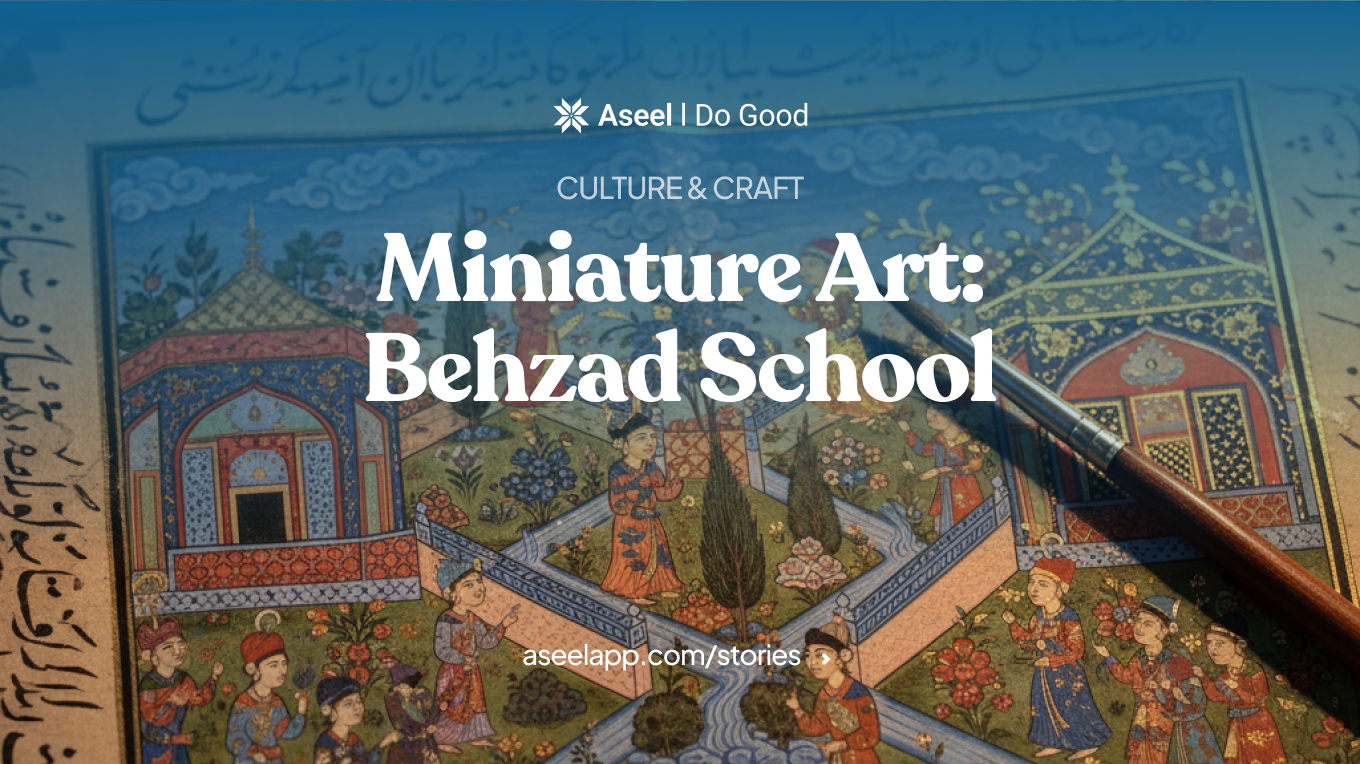
Hand-painted Afghan miniature artwork Collection
Who Behzad was
Behzad was the most celebrated painter of the Herat school, and the artist the Smithsonian credits with "introducing a new sense of naturalism into Persian painting."
According to Encyclopaedia Iranica, in an entry by the specialist Priscilla P. Soucek, Behzad was orphaned as a youth and was "reared and trained by Mīrak," the painter Ruh-Allah Mirak Naqqash. He worked first as a subordinate of Mirak under the patronage of Mir Ali-Shir Nava'i, then under Sultan Husayn Bayqara, entering the sultan's service shortly before 883 AH, corresponding to 1488 CE.
That detail sets the pattern for everything that follows in this article: a named master, a named student, and a skill passed directly from one to the other.
His career did not end when Timurid Herat did. After Muhammad Shaybani Khan took the city in 913 AH, or 1507, Iranica lists Shaybani Khan, ruling from 1507 to 1510, among Behzad's patrons. The familiar account in which Behzad flees Herat straight to the Safavid court is not what the strongest source describes.
What the record supports, and what it does not
Popular accounts give Behzad's dates with a confidence the sources do not share. Here is what the authorities actually say.
| Source | Birth | Death |
|---|---|---|
| Encyclopaedia Iranica | No date given. One painting inscription says he executed it "during his seventieth year," but that painting cannot be precisely dated | 935 AH / 1535 to 1536 CE, from a chronogram |
| Britannica | c. 1455, with Britannica's own question mark | c. 1536, also with a question mark |
| Encyclopedia of World Biography | "there is no record of his birth or death" | c. 1530 |
| EBSCO Research Starters | c. 1450 | c. 1535 |
| World History Encyclopedia | c. 1450 | 1535 |
No birth record survives. Authorities place it somewhere between roughly 1450 and 1460, always hedged, and the most rigorous of them declines to give one at all. Death is usually placed at 935 AH, 1535 to 1536 CE, on chronogram evidence.
His burial place is likewise unsettled. The commonly repeated claim is the Tomb of Two Kamals in Tabriz, alongside the poet Kamal Khujandi. A competing claim places him in Herat. Reliable evidence was not found in any museum or peer-reviewed source settling the question.
One more widely repeated claim deserves a caution. You will read that in 1522 Behzad was appointed director of the royal library by Shah Isma'il, and held the post until his death. Encyclopaedia Iranica records that the decree dated 928 AH, corresponding to 1522, has its authenticity questioned because of chronological discrepancies with the document's preservation context, and that Safavid sources instead specify employment under Shah Isma'il's successor, Shah Tahmasp.
Which paintings are securely his
Very few. Britannica states the problem plainly: "A major problem in assessing Behzād's work precisely is the difficulty in identifying specific works as coming from his hand." Students imitated him closely, later collectors attached his name without evidence, and he signed few paintings. When he did sign, Iranica records that his signatures were "either incorporated into architectural inscriptions or placed inconspicuously on an object in the painting."
| Work | Location | Standing |
|---|---|---|
| Bustan of Sa'di, text colophon 893 AH / 1488 | National Library of Egypt, Cairo | Most secure. Sheila Blair's peer-reviewed study records that the inscription "work of Bihzad" appears on all four paintings, two as small signatures on objects and two worked into architecture |
| An Old Man and a Youth | Freer Gallery, Smithsonian, Washington | Signed, per the Smithsonian |
| Khamsa of Nizami, Or. 6810 and Add. 25900 | British Library, London | Disputed. The British Library records that the names of Mirak and Bihzad were "written underneath it at an unknown date." One painting is ascribed to Bihzad underneath but to Qasim ʻAli in the text panel |
| Mantiq al-tayr of Attar, 888 AH / 1483 | Metropolitan Museum of Art, New York | Frequently attributed, not secure |
| Khamsa of Ali-Shir Nava'i, 890 AH / 1485 | Bodleian Library, Oxford, and John Rylands Library, Manchester | Frequently attributed, not secure |
| Zafar-nama of Yazdi, 872 AH / 1468 | Johns Hopkins University, Garrett collection | Largely rejected. The attribution rests on a later Mughal inscription, and most modern scholars doubt it because Behzad would have been roughly 13 to 23 |
The Mughal emperor Jahangir claimed in 1605 that about sixteen of the pictures in British Library Or. 6810 were Behzad's, without specifying which. For the bathhouse scene on folio 27v, showing Harun al-Rashid and the barber, the Library notes that most scholars would attribute it to Behzad. That phrasing, what most scholars think rather than what is proven, is the correct register for this material.
Britannica states that only 32 paintings are definitively attributed to him, all made between 1486 and 1495. That figure could not be corroborated in a museum or peer-reviewed source, so it should be read as Britannica's count rather than settled consensus.
What makes Afghan miniature art distinctive
Set the attribution puzzle aside and the visual language itself is remarkably consistent, and remarkably durable. These are the features that carried forward.
| Feature | What it means | Evidence |
|---|---|---|
| Scenes drawn from literature | The tradition illustrates poetry and history rather than inventing subjects. The core manuscripts are Sa'di's Bustan, Nizami's Khamsa, Attar's Mantiq al-tayr and Yazdi's Zafarnama | UNESCO describes the 2025 element as "a detailed and symbolic form of painting scenes from history and literature" |
| Symbolic rather than realistic proportion | Figure size signals importance in the scene, not distance from the viewer | UNESCO's description of the art of miniature notes that figure size reflects importance rather than realistic proportion |
| Architecture as structure | Painted buildings, portals and tiled inscriptions frame and organise the scene. Behzad hid signatures inside painted architectural inscriptions, which tells you how detailed and legible that architecture was | Encyclopaedia Iranica on his signature practice; Sheila Blair on two signatures worked into architecture in the Cairo Bustan |
| Density of detail | Every surface carries pattern. The final detailing stage has its own name, pardakht | British Institute of Persian Studies |
| Naturalism within convention | Behzad's contribution was greater lifelikeness in figures and gesture, inside an otherwise stylised system | The Smithsonian credits him with "introducing a new sense of naturalism into Persian painting" |
| Prepared, tinted paper | Paper was dyed with natural substances including flowers, herbs and fruit juice. Plain white was avoided, on the reasoning that it could deceptively affect the viewer's perception | British Institute of Persian Studies |
| Gold applied by hand | Shell gold, made by pounding gold between layers of deerskin into a very thin leaf, then grinding it with honey | British Institute of Persian Studies |
The materials deserve their own note, because they explain both the colour and the cost.
| Material | Source |
|---|---|
| Blue | Lapis lazuli |
| Green | Malachite |
| Red | Earth pigment, red ochre |
| Other colours | Herbs and plant sources |
| Binder | Gum arabic or egg yolk |
| Gold | Shell gold, ground with honey |
One popular claim to set aside. You will often read that these paintings were made with a brush of a single squirrel or kitten hair. The British Institute of Persian Studies note refers only to "the finest brush." Reliable evidence was not found for the single-hair claim.
The tradition continues
What UNESCO recognised, and what it did not
There are now two separate inscriptions in this area, and conflating them is the most common error in current coverage.
| Element | Year | Session and file | Submitted by | What it covers |
|---|---|---|---|---|
| Art of miniature | 2020 | 15.COM, file 01598 | Azerbaijan, Iran, Türkiye, Uzbekistan. Afghanistan is not included | Small paintings on books, papier-mâché, rugs, textiles, walls, ceramics and other items, using gold, silver and organic substances |
| Behzad's style of miniature art | 2025 | 20.COM, file 02267, New Delhi, 8 to 12 December 2025 | Afghanistan alone | A detailed and symbolic form of painting scenes from history and literature, appearing on minarets and historic buildings as well as on paper, with artists continuing to draw on Behzad's distinctive design approach |
This brings Afghanistan to five inscribed elements, alongside Nawrouz (2024), the rubab (2024), Yaldā or Chella (2022), and sericulture and traditional silk production (2022). Afghanistan ratified the Convention on 30 March 2009.
The phrase to notice in the 2025 listing is "artists continue." UNESCO inscribed this as a living practice, not a historical record.
A shared heritage, handled honestly
The 2025 inscription drew objection from Iran. Iran's Deputy Cultural Heritage Minister, Ali Darabi, was reported as stating that Afghanistan had registered a small part of a general miniature-art file that Iran had previously registered as "Behzad Herat School."
That is a quoted political position. It is also checkable. Iran's UNESCO country page lists 27 inscribed elements, and no element named "Behzad Herat School" appears among them. Iran's 2020 element is titled simply "Art of miniature."
The underlying question deserves a calm answer. Herat is in modern Afghanistan. The court language and literary culture of Timurid Herat were Persian and Chaghatay Turkish. The Timurid state maps onto no modern nation, and its artistic tradition fed directly into the Safavid, Ottoman and Mughal worlds, as the Metropolitan Museum notes. UNESCO's intangible heritage files are not claims of exclusive ownership, and elements can be extended to include additional states.
This is shared heritage with a specific geography. Herat's role in it has been under-acknowledged in English-language sources rather than over-claimed.
From the manuscript page to the object
The most important thing that happened to this tradition is that it moved off the page.
The royal book workshop no longer exists, and neither does the patronage system that funded it. What survived is the visual language and the technical method, and both migrated onto whatever surfaces artists could sell. UNESCO's 2025 description itself records the style appearing on minarets and historic buildings as well as on paper.
Contemporary reporting shows the same migration at a domestic scale. Alive-in documented the Hashemi family of Herat, in which Feraiba Hashemi trained at the Kamaluddin Behzad Vocational Institute and then taught her siblings Yasamin, Fahima and Fatana, working alongside their parents Saeed Akram Hashemi and Shigofa. Their work is applied to glass pitchers, bowls, jugs, wedding sets, flower pots and picture frames, commissioned through antique shops. The glass they paint on is frequently Herat's own hand-blown glassware, which links the two crafts more closely in practice than either is usually described.
That report also records the economics: between 300 and 800 Afghanis per piece, with output falling from five sets a week to two after the economic collapse of August 2021.
How the skill still transmits
The master-to-student chain that produced Behzad has never actually broken. The institutions changed; the method did not.
| Institution | Where | What the record shows |
|---|---|---|
| Kamaluddin Behzad Vocational Institute | Herat | Named for the painter. Trained Feraiba Hashemi, who then taught her three sisters |
| Turquoise Mountain Institute | Kabul | Ran a three-year ceramics curriculum from 2007 and trained artists across several crafts. Khalida Marefat of Asman Arts trained there for three years in miniature painting and graduated with honours |
| Gholam Mohammad Maimanagi centre | Kabul | Rendered as "Memanagi Center" and "Mimangi Art Gallery" on different Aseel vendor pages. Trained both Mohammad Bashir Paikan, who began in 1981, and Ahmadshah Arghandiwal, who began in 2005 |
| Shahr-e-Danesh institute | Kabul | Where Edrisa Walizada of Pamir Arts developed miniature skills under Masoudeh Amiri |
| Firouz Koh Institute | Kabul | Art department. Walizada enrolled there subsequently |
| American Institute of Afghanistan Studies | Kabul and Herat | Produced high-resolution reproductions of 15th to 18th century miniatures on Dibond aluminium: 69 images from 17 collections at the Queen's Palace in Babur Gardens, and 106 images from 20 collections installed permanently at the Herat Citadel |
What the current restrictions mean'
The tradition faces a direct constraint. Under the current ban on depicting living things, AFP reported in February 2026 that faces on panels about the city's history at the Herat Citadel have been painted black, and an exhibition space padlocked. Human faces are a common feature of Behzad-style work. Those citadel panels are the same reproductions the American Institute of Afghanistan Studies installed to bring the paintings home.
The same reporting named three working Herat miniaturists: Mohammad Younes Qane, then 45, Parisa Narwan, 24, and Asia Arnawaz, 22. Qane has closed his gallery and works from home, describing clients as rare and exhibitions as non-existent. Around a dozen women paint miniatures on glass or paper in a workshop and sell through social media and personal contacts. Narwan cannot access international scholarships or exhibitions because of visa difficulties.
This is also why the non-figurative branches of the tradition, calligraphy and tazhib illumination, are where most commercial activity now sits. They are unaffected by restrictions on depicting living things.
Meet today's artisans
Centuries after Behzad's work was made in Herat, Afghan artists continue to reinterpret this visual tradition in new forms. Among them are contemporary artisans whose miniature and calligraphic work brings the intricate language of Afghan art onto handmade pieces made for modern homes.
What follows is not a general claim about heritage. Every founder name, training lineage, city and date below comes from that workshop's own page.
Paikan Gallery, Kabul
Mohammad Bashir Paikan began in 1981, aged 16, driven by what his page describes as an unwavering passion for calligraphy and Islamic miniature painting. He holds a master's degree in fine arts, and trained under his elder brother Mohammad Munir Paikan and for three years at the Gholam Mohammad Memanagi Center. On Aseel since 2023.
The gallery's Sa'di poem calligraphy is the piece that shows the tradition's technical vocabulary most clearly. The listing gives the script as Sols and Naskh, the material as Simin Khat colour on paper, the size as 50 by 70 cm, and the artist as Mohammad Munir Paikan: the elder brother who taught the founder. Teacher and student, both working, both named on the page. Five hundred years after Mirak trained Behzad, the structure is identical.
See Paikan Gallery.
Asman Arts, founded in Kabul
Khalida Marefat is a miniature painter from Kabul with 25 years in the tradition. She trained for three years at the Turquoise Mountain Institute and graduated with honours. She founded the studio as a collective of two artists; it now has four, working in miniature painting, calligraphy and Islamic design, and has exhibited locally and internationally. On Aseel since 2023. The studio now operates from Virginia.
See Asman Arts.
Ahmad Shah Hazeri Gallery, Kabul
Ahmadshah Arghandiwal started his brand in 2005, aged 19, and has 20 years in the arts. He studied at the Gholam Mohammad Mimangi Art Gallery and holds a bachelor's degree in economics and management. The gallery works with 10 artists on calligraphy of Quranic verses, surahs and the Asma-ul-Husna, sourcing raw materials from art sectors across Afghanistan. On Aseel since 2022.
Their Al-Wahid calligraphy, one of the ninety-nine names of Allah, is framed with floral motifs and gold detailing.
See Ahmad Shah Hazeri Gallery.
Pamir Arts, Kabul
Edrisa Walizada started her brand in 2016, aged 15, having finished tenth grade. She began with drawing, moved to calligraphy, then developed miniature skills under Masoudeh Amiri at the Shahr-e-Danesh institute, and later enrolled in the art department at Firouz Koh Institute. On Aseel since 2023.
Her Persian calligraphy and floral mandala work is miniature work on A4, 21 by 29.7 cm. The listing notes the paper is a century-old handmade type, durable and decay-resistant, and cautions that it should be handled carefully because of substances in it. That is an unusually candid material disclosure, and it echoes what the British Institute of Persian Studies records about miniature painters preparing paper rather than working on plain stock.
See Pamir Arts.
Bastani Wooden Products, Kabul
This workshop makes an Islamic miniature and Arabic calligraphy artwork at 65 by 55 cm, described as watercolour, Islamic miniature, calligraphy and gilding together, on a white ground with mahogany red borders and black script, and stated as purely handmade in Afghanistan.
Gilding is tazhib, and it is the same technique described earlier in this article: gold beaten into leaf, ground, applied by hand. A contemporary Kabul workshop listing gilding as a stated technique alongside miniature and calligraphy is the clearest available evidence that the full historical method survived.
One training lineage, two workshops, twenty-four years apart
| Artist | Workshop founded | Trained at |
|---|---|---|
| Mohammad Bashir Paikan | 1981, aged 16 | Gholam Mohammad Memanagi Center, three years, plus his elder brother Mohammad Munir Paikan |
| Ahmadshah Arghandiwal | 2005, aged 19 | Gholam Mohammad Mimangi Art Gallery |
Two Kabul workshops, founded a generation apart, trained at the same institution. That is what a living tradition looks like from the inside, and it is the same mechanism that produced Behzad.
Discover the art on Aseel
At Aseel you can discover handmade pieces created by Afghan artisans, from miniature and calligraphic artwork to traditional crafts reimagined for contemporary life.
What is available, and what it costs
| Piece | Workshop | Detail | Price |
|---|---|---|---|
| Al-Wahid calligraphy | Ahmad Shah Hazeri Gallery | Framed, floral motifs, gold detailing | $51.75 |
| Islamic miniature and calligraphy artwork | Bastani Wooden Products | 65 x 55 cm, watercolour, miniature, calligraphy and gilding | $83.95 |
| Persian calligraphy and floral mandala | Pamir Arts | Miniature on A4, 21 x 29.7 cm, century-old handmade paper | $98.90 |
| Sa'di poem calligraphy | Paikan Gallery | 50 x 70 cm, Sols and Naskh script, artist Mohammad Munir Paikan | $290.95 |
Roughly 50 to 290 US dollars, with price tracking size, technique and the artist's standing rather than anything arbitrary. Browse the full range in miniature art and calligraphy.
What to expect when you buy
Aseel's Buy Good page is upfront that this is "slow production and delivery worth the purchase every time," which is an honest description of buying directly from a small workshop rather than from held stock. The platform states that it lets you "buy directly from artisans in unexplored parts of the world," and that "every purchase elevates a community." Free shipping and free returns apply.
Pieces do go out of stock. The Bastani artwork was unavailable at the time of writing. A four-artist studio does not hold inventory the way a print shop does, and that is a consequence of the thing being handmade rather than a fault in the service.
What you cannot buy
There is no market in Behzad originals. The securely attributed work is in Cairo, London, Washington and Oxford, and it is not for sale. Any seller implying otherwise is misleading you.
What is available is work in the tradition he shaped, from workshops that can name who taught them. Given how much of this article concerns the difficulty of attributing a painting to a named hand five centuries later, there is something worth noting in buying from an artist who signs their work and credits their teacher.
Frequently asked questions
What is Afghan miniature art?
A tradition of small, highly detailed painting that developed in Herat under the Timurid dynasty in the fifteenth century, illustrating scenes from history and literature. It uses symbolic rather than realistic proportion, dense ornament, painted architectural settings, mineral pigments such as lapis lazuli and malachite, and hand-applied gold. UNESCO inscribed "Behzad's style of miniature art" under Afghanistan's name in December 2025.
Who was Kamal ud-Din Behzad?
The leading painter of the Herat school, active from the 1480s. Orphaned young, he was trained by the painter Mirak, worked under the patronage of Mir Ali-Shir Nava'i and then Sultan Husayn Bayqara in Herat, later worked for Shaybani Khan, and is credited by the Smithsonian with introducing a new naturalism into Persian painting.
When was Behzad born?
No birth record survives. Authorities place it between roughly 1450 and 1460, always hedged, and Encyclopaedia Iranica gives no date at all. His death is usually placed at 935 AH, 1535 to 1536 CE, on chronogram evidence.
Was Behzad Afghan or Iranian?
He worked in Herat, a city in what is now western Afghanistan, at a Timurid court whose literary culture was Persian and Chaghatay Turkish. The Timurid state corresponds to no modern country. Both Afghanistan and Iran have legitimate connections to this heritage, and UNESCO's lists are not claims of exclusive ownership.
Did UNESCO recognise Afghan miniature art?
Yes. In December 2025, at its twentieth session in New Delhi, UNESCO inscribed "Behzad's style of miniature art" under Afghanistan's name, file 02267. This is separate from the 2020 "Art of miniature" inscription, submitted by Azerbaijan, Iran, Türkiye and Uzbekistan, which does not include Afghanistan.
Is miniature painting still practised in Afghanistan?
Yes, though under difficulty. Herat has a vocational institute named for Behzad, and named artists continue to work, applying miniature painting to glassware and paper and selling largely through social media. Kabul workshops founded between 1981 and 2016 continue in miniature painting, calligraphy and illumination, each trained by a named master. Under the current ban on depicting living things, faces on painted historical panels at the Herat Citadel have been painted black.
What is tazhib?
The illumination tradition that accompanies miniature painting and calligraphy: gilded and painted borders, panels and floral work. Because it is non-figurative, it is unaffected by current restrictions on depicting living things, which is part of why it remains the most commercially active branch of the tradition.
Which paintings are definitely by Behzad?
Very few. The most secure group is the four paintings in the Bustan of Sa'di in Cairo, each carrying the inscription "work of Bihzad," plus a signed painting at the Freer Gallery in Washington. Many famous attributions, including those on British Library Or. 6810, are later inscriptions added at unknown dates, and one contradicts the text panel, which credits Qasim ʻAli.
Can you buy Afghan miniature art today?
Not the historic work, which sits in museum and library collections and is not for sale. Contemporary work in the tradition is available: on Aseel, pieces from Kabul-founded workshops run from roughly 51 to 291 US dollars, covering calligraphy, Islamic miniature and gilded illumination.
The through-line
Behzad was trained by a painter named Mirak, in a workshop where a dozen specialists worked on one book. Five hundred years later, in Kabul, Mohammad Bashir Paikan was trained by his elder brother and at a named art centre, and sells work signed by that same brother.
Between those two points sit the fall of a dynasty, the loss of the patronage that funded the art, the departure of the manuscripts to libraries in Cairo, London, Oxford and Washington, decades of war, and a present-day restriction on painting the human face. The tradition narrowed. It moved from royal manuscripts to glassware, picture frames and framed panels. It leaned into the non-figurative branches that were still permitted.
What it did not do is stop. UNESCO's 2025 wording, that artists "continue drawing inspiration from Kamal ud-Din Behzad's distinctive design approach," is a statement of present tense, and it is accurate.

Media Inquiries
For media inquiries, press requests, or interview opportunities related to this article or Aseel, please contact:
About Aseel
Aseel is a tech-driven startup providing a digital marketplace where artisans can sell their one-of-a-kind handcrafted products while supporting humanitarian efforts worldwide. We champion using practical skills to create the positive impact businesses and communities deserve. Aseel's intuitive platform empowers thousands of makers by connecting them with a global audience. Transparency and privacy are at the heart of everything we do. Our dedicated customer service team is available anytime to assist clients through our secure and protected platform.
Follow Aseel on Google
Add Aseel as a preferred source on Google to see more of our stories in your Search results.